We’ve been examining iconic Gospel scenes that Mark hyperlinked to Psalm 93. These hyperlinks stack up insightful comparisons, envisioning Jesus in a fresh way within that psalm. Conversely, Psalm 93 as a second eye on Jesus and His great works in Mark’s Gospel wondrously enlarges our depth perception. As we see and believe what’s true of Christ, we then progressively experience what’s true in Him. Before resuming our analysis of these hyperlinks to Psalm 93, we’ll explore a related set of hyperlinks that help us spot Jesus from the pages of the Old Testament.
Mark’s Mount of Transfiguration scene has literary hyperlinks (surprise!) to an Old Testament narrative. “And a cloud overshadowed them, and a voice came out of the cloud, ‘This is my beloved Son; listen to him’” (Mk 9:7). This dazzling phenomenon hyperlinks to the cloud overshadowing the tent of meeting on Mount Sinai. This pillar of cloud first met up with terrified Israel escaping Pharaoh’s army on the shore of the Red Sea. That protective cloudy column then led them like a caring shepherd through the wilderness (Ps 78:14, Neh 9:12). At Mount Sinai it came to rest on the tabernacle upon its completion, the scene that Mark links the Mount of Transfiguration to.
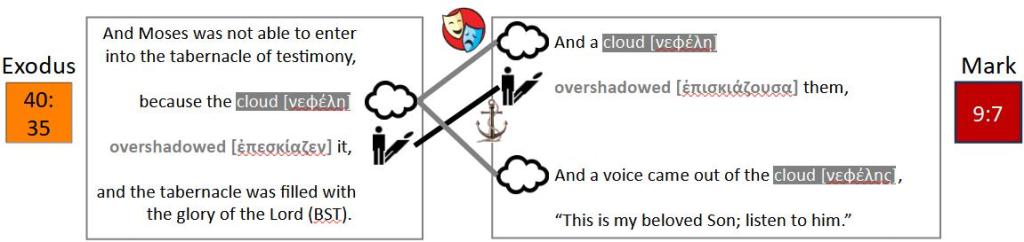
“And a cloud overshadowed them.” Overshadowed is episkiazousa (ep-ee-skee-ah’-zoo-sah), a present active participle of episkiazō (ep-ee-skee-ahd’-zoh), to throw a shadow upon or to envelop in a shadow.
The silver anchor icon beside episkiazousa indicates a one-time episkiazō appearance in Mark and multiple appearances in the Septuagint. Of the 4 times episkiazō shows up in the Septuagint, only once does cloud, nephelē (nef-el’-ay), also appear: Exodus 40:35. Mark uses nephelē two other times, one of which we’ll cover shortly. So the cloud is thematically linked, as indicated by the theme icon above. Within the larger storylines, these parallel scenes feature Moses, tabernacles, a divinely animated cloud, and glory. But to narrow our focus on these hyperlinks, we’ll concentrate on the overshadowing of the cloud.
The cloud overshadowing the tabernacle of testimony was first introduced to Israel at a critical juncture of deep distress. “Then the angel [mal’āḵ] of God who was going before the host of Israel moved and went behind them, and the pillar of cloud moved from before them and stood behind them, coming between the host of Egypt and the host of Israel” (Exod 14:19-20). Hebrew mal’āḵ (mal-awk’) is in my opinion unfortunately translated “angel” in just about every English translation. Mal’āḵ conveys function, one who delivers a message, not what it looks like. Here’s an instance where how we think really deviates from Hebrew thought. The Hebrews visualized their world primarily as actions and activity (i.e., verbs), whereas we, thanks to our Greek linguistic ancestry, see our world more as how things look like (i.e., nouns). “Angel” conjures in our minds appearance—a winged being populating the heavenly realm—not its function: delivering a message. So translating mal’āḵ as “angel” has an unintended consequence for us to envision a created winged being to the exclusion of the uncreated communicative Word, as is actually the case in some contexts.
It is significant to note that this pillar of cloud had only one inhabitant: the messenger of God. So who is this messenger of God in the cloudy column? “And in the morning watch the LORD in the pillar of fire and of cloud looked down on the Egyptian forces and threw the Egyptian forces into a panic” (verse 24, emphasis added). It’s the LORD—Yahweh! So all this Old Testament background material teases out a supremely weighty inference at the Mount of Transfiguration.
“Behold, I send an angel [mal’āḵ] before you to guard you on the way and to bring you to the place that I have prepared. Pay careful attention to him and obey his voice; do not rebel against him, for he will not pardon your transgression, for my name is in him” (Exod 23:20-21).
This Messenger was to bring them from their current location at Sinai through the wilderness to the prepared place, which we refer to as the Promised Land, Canaan. The pillar of cloud and fire and the Messenger, therefore, had the same shepherding commission to lead God’s flock and guard it. “Pay careful attention to him” in the Septuagint is eisakoue autou (εἰσάκουε αὐτοῦ); the Father’s voice from the cloud on the mount is akoute autou (ἀκούετε αὐτοῦ). Eisakoue (ahys-ah’-koo-eh) is an intensification of akouete (ah-koo’-eh-teh), the former meaning to hear and obey. Psalm 99:7 recapped the outcome: “In the pillar of the cloud he [Yahweh] spoke to them; they kept his testimonies and the statute that he gave them.” So God says of the cloud-dwelling Messenger and of Jesus, “Listen to him.” The not-so-subtle takeaway is that Jesus is the Messenger dwelling in the pillar of cloud! This Messenger, who was none other than Yahweh Himself, prefigured Jesus Christ, the eternal Word who became flesh and tabernacled among us (Jn 1:14).
Comparing these two cloud scenes accentuates important similarities and important differences. “And Moses was not able to enter the tent of meeting because the cloud had dwelt on [epeskiazen] it, and the glory of Yahweh filled the tabernacle” (Exod 40:35 LSB). Interestingly, the Septuagint translates the Hebrew word for šāḵan (shaw-kan’), “dwelt on,” as episkiazō, the same word Mark used for “overshadowed.” How is it that “dwell” and “overshadow” could be so interchangeable? That’s not very intuitive, at least not for me at first. Well, in the Hebrew dynamic way of envisioning the world, the shadow or shade is that comfortable, pleasant environment where life—dwelling—happens. Several other Hebrew Bible passages make this clear.
“On the mountain height of Israel will I plant it, that it may bear branches and produce fruit and become a noble cedar. And under it will dwell every kind of bird; in the shade of its branches birds of every sort will nest” (Ezek 17:23). So it’s the shade of this great cedar tree in which the birds nest and dwell. This same idea of dwelling and overshadowing is conveyed elsewhere in Ezekiel: “All the birds of the heavens made their nests in its boughs; under its branches all the beasts of the field gave birth to their young, and under its shadow lived all great nations” (Ezek 31:6).
We see how needful shade is by observing Jonah’s plight. “Now the Lord God appointed a plant and made it come up over Jonah, that it might be a shade over his head, to save him from his discomfort. So Jonah was exceedingly glad because of the plant” (Jonah 4:6). When God took away the plant and its shade, “the sun beat down on the head of Jonah so that he was faint.”
David, the sweet psalmist of Israel, has insightful wordplays with shadow and dwelling.
Be merciful to me, O God, be merciful to me,
for in you my soul takes refuge;
in the shadow of your wings I will take refuge,
till the storms of destruction pass by. (Ps 57:1 ESV)
A common feature of Hebrew poetry is parallelism. Though this definition is oversimplified, parallelism is one line contrasted with or amplified by the next line. See how “I will take refuge” in the third line echos “my soul takes refuge” of the second line? “My soul” and “I” are the same, which is obvious. This sets up a parallelism that’s not quite so apparent. Observe how “in the shadow of your wings” echos “in you.” This shadow is synonymous with God Himself! In other words, God’s overshadowing David was shade that provided refuge for him.
What’s more is that through Mark’s hyperlinking with Psalm 93:4’s “voices” and “waters,” Jesus’ baptism in the river is brought into alignment with Jesus’ overshadowing by the cloud:
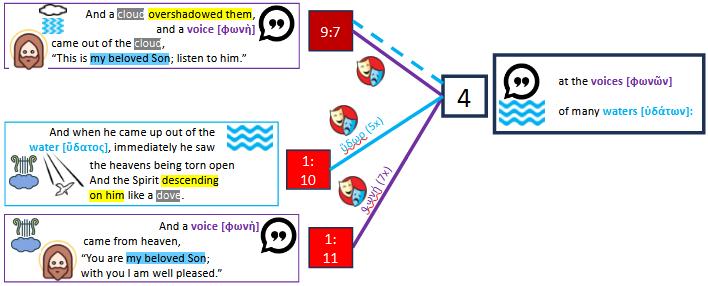
This hyperlinking makes conspicuous the river and the cloud as “waters.” As many times as I’d read this scene, until I saw Mark’s parallel with Psalm 93, I’d not thought of this cloud on the mountain as a rain cloud. A glory cloud, yes. But a rain cloud?
“And a cloud overshadowed them, and a voice came out of the cloud, ‘This is my beloved Son; listen to him’” (Mk 9:7). The word for cloud is nephelē (nef-el’-ay), one associated with rain, as the following usages demonstrate. “He also said to the crowds, “When you see a cloud [nephelēn] rising in the west, you say at once, ‘A shower is coming.’ And so it happens” (Lk 12:54). In Judges 5:4 the Septuagint translated clouds as nephelē: “the clouds [nephelai] dropped water.” Again, after Elijah’s dramatic confrontation on Mount Carmel: “And in a little while the heavens grew black with clouds [nephelais] and wind, and there was a great rain” (1Ki 18:45). So the Father’s “listen to him” emanates from a rain cloud.
Rewinding to the beginning of creation, on Day 2 God separated the waters below from the waters above. The waters of the Jordan where the Father’s voice was heard are waters below. The rain cloud as the epicenter of the Father’s voice is waters above. The voices of many waters then is two-fold: the Father’s voice first at the Jordan River and second from within the rain cloud. This clever comparison seems to at least suggest this much: the voice coming out of the cloud is like rain. This is not a new concept. Moses drew this connection: “May my teaching drop as the rain, my speech distill as the dew, like gentle rain upon the tender grass, and like showers upon the herb” (Dt 32:2 ESV). Perhaps the best metaphor of divine words as rain is showcased by the prophet Isaiah:
“For as the rain and the snow come down from heaven and do not return there but water the earth, making it bring forth and sprout, giving seed to the sower and bread to the eater, so shall my word be that goes out from my mouth; it shall not return to me empty, but it shall accomplish that which I purpose, and shall succeed in the thing for which I sent it” (Isa 55:10-11 ESV).
The rain of the skies has a spiritual counterpart in the realm of God’s heavens: Jesus’ words. Jesus’ word is the Father’s word that goes from His mouth (Jn 12:50), so much so that the Father could boldly assert, “This is my beloved Son; listen to him.” “Listen to him” validates Jesus as the Father’s spokesman, His representative voice (see Heb 1:1-2), even as the Messenger was (Exod 23:20-21). Just as the Father’s voice is like rain and snow coming down from the clouds, so too is the voice of Jesus. As the Bible nears its climax, Jesus’ voice is “like the roar of many waters” (Rev 1:15). It’s reminiscent of the paradise garden in its pristine state before sin entered in and desecrated it. Before there was rain, a river watered the garden of Eden. That “roar of many waters” was probably what it sounded like in Eden, for there the fountainhead of four mighty rivers gushed out to the whole world.
Let’s explore a bit the Mount of Transfiguration placed in parallel with “the Son of Man seated at the right hand of Power”:

Clouds highlight both scenes. On the left Power personifies the Father, as “at the right hand of Power” represents Christ’s royal position on the throne alongside His Father. “A voice came out of [ek] the cloud.” The voice out from within (which is what ek in Greek means) the cloud indicates that the Father was present inside that cloud. There’s union and unity between Father and Son. Jesus together with His Father—at the right hand of the Power—within the glorious rain cloud signifies the very highest authority! He’s raining down words of royal authority to the earth to execute what pleases Him—to “accomplish that which I purpose, and shall succeed in the thing for which I sent it” (Isa 55:11).
Jesus’ cloud is superior to Israel’s cloud. The pillar of cloud is never said to have brought rain to Israel, but Jesus’ cloud is associated with Psalm 93’s waters. It’s a better cloud! It not only shelters from the stifling heat of the sun but delivers refreshing, life-giving waters, the words of Jesus as life-blessing waters of the rains that shower the earth. “It is the Spirit who gives life; the flesh is no help at all. The words that I have spoken to you are spirit and life” (Jn 6:63).
Mark’s Mount of Transfiguration hyperlinking to the cloudy pillar at Mount Sinai yields another amazing insight. “For he [Peter] did not know what to say, for they [Peter, James and John] were terrified. And a cloud overshadowed them” (9:6-7). “Them” is the preceding “they,” the three terrified amigos: Peter, James and John. These three disciples were enveloped within the cloud. This is a huge difference from before, where the cloud barricaded Moses from entering the tabernacle. And, as we’ve just seen, only the Messenger of God, Yahweh Himself, lived in the cloud and no one else. The cloud overshadowing Jesus on the mount is a superior cloud for it grants man access to God. It’s a picture of life inside the Holy of Holies in God’s presence through the torn veil!
Let’s take one last look at Jesus’ baptism in the river synced up with Jesus’ overshadowing by the cloud:
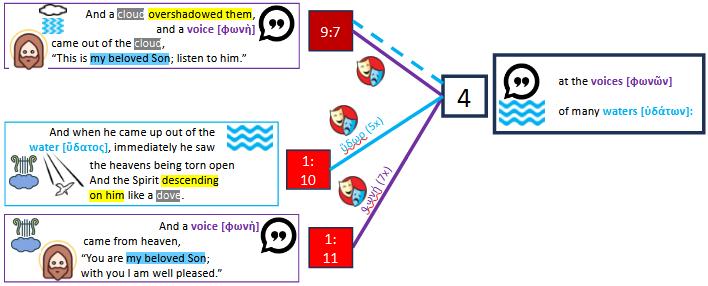
Mark’s compares a triad in both scenes. The Father, the Son and the dove at the river correspond with the Father, the Son, and the cloud at the mount. We know the identity of the dove, for the verse acknowledges that it’s the Holy Spirit. But what about the cloud? What identity does it have (if it does)? Mark’s deliberate structuring of these scenes as a chiasm nudges us towards a conclusion that the dove and the cloud are both emblems of the Spirit! The Holy Spirit throughout the Bible is often emblemized by inanimate objects like wind, breath, water, oil, and fire. So representing the Spirit as a cloud fits the part.
Mark’s Gospel colleague, Luke, also bears witness to this. In addition to using episkiazō of the cloud as Mark does, Luke’s only other use of episkiazō is in connection with the Spirit. “The Holy Spirit will come upon you, and the power of the Most High will overshadow [episkiasei] you; therefore the child to be born will be called holy—the Son of God” (Lk 1:35). Overshadowing people for the purpose of glorifying Jesus is something the Holy Spirit does. Overshadowing people in close proximity to Jesus is what the cloud does.
So what does this mean for our faith? The Spirit, being God Himself, cannot be fully expressed by one analogy. Fire is good but incomplete. Water is wonderful but incomplete. Wind is expressive but is unable to completely plumb the depths of who the Spirit is. Cloud highlights some unique aspects that these other symbols do not. Yet we must keep in mind that cloud is also incomplete. We need all these Scriptural revelations to form a truth mosaic of who the Spirit of God is and what His role is among God’s people.
Over my Christian life so much of my difficulties comprehending the Spirit have come, as I alluded to earlier, from my Greek underpinnings of visualizing the world and the world of the Bible. The Father as a person I can visualize. The Son as a person also is easily to envision. But the Spirit as a person? Much more challenging, even though in my head I know He is the third Person of the Trinity. A big part of the problem is that my picture-fixated mind only has impersonal biblical representations of the Spirit to grab a hold of—wind, breath, water, oil, fire. The predominance of these impersonal symbols pull at my thoughts like a tractor beam towards the Spirit as “It” rather than “He.” I have been learning more recently, and slowly, that these emblems used of the Spirit in the Hebrew mind were functions far more so than for visual objects for my imagination. In other words, to relate personally to the Spirit of God, I’m not to fixate on what water or rivers look like so much as what water accomplishes or achieves. It’s in the doings of the Spirit that I recognize the Spirit personally.
So in thinking of the Spirit through the emblem of a cloud, what doings shall I dwell on? The cloud shelters from the stifling heat of the sun, providing shade for comfort; the Spirit is called the Comforter. The cloud provides guidance; the Spirit leads and guides. The cloud pours down rain to sustain life; the Spirit is living waters who keeps us alive and thriving. The cloud prepares us to hear the words of God’s Messenger; the Spirit reminds us of all that Jesus said. The cloud both veils and unveils Yahweh; so, too, the Spirit. I believe that if we focus our hearts by faith on what the cloud does rather than what it looks like we’ll come to know the Spirit more personally just like we do the Father and the Son.
Lastly, let’s worship and adore our Lord Jesus for gifting us with a superior cloud! Jesus, having passed through the baptism of sufferings that the Jordan River intimates, “ascended far above all the heavens, that he might fill all things” (Eph 4:10). It’s the cloud what welcomes us into God’s presence. It’s the cloud that comforts us with shade from the fiery trials we encounter in this world. It’s the cloud that blesses us with the life-giving rain of Jesus words to renew and refresh our parched souls. “If anyone thirsts, let him come to me and drink. Whoever believes in me, as the Scripture has said, ‘Out of his heart will flow rivers of living water.’” Now this he said about the Spirit, whom those who believed in him were to receive, for as yet the Spirit had not been given, because Jesus was not yet glorified” (Jn 7:37-39).
 Glory Unveiled: Discovering Jesus