The apostle Paul intriguingly commented on Israel’s history that “all were baptized into Moses in the cloud and in the sea.” What does that mean? I’ve never studied it until recently when the Gospel of Mark’s beautifully arranged cloud scenes anchoring Old Testament event to New Testament fulfillment in Jesus nudged me in that direction. Mark presents a baptism into Jesus, the true Moses, in the cloud. So what is this? How important is this “baptism in the cloud” for my Christian life?
As demonstrated in recent blogs with Psalm 93, Mark is an Olympian gymnast gold medalist with words. His Spirit-enabled abilities to hyperlink to Old Testament scenes (framed by the Greek translation at the time, the Septuagint) are brilliant and stunning. It’s not just Psalm 93 either. His artistic finesse and symmetrical structuring is happening all throughout his narrative. To help recognize these repeating literary patterns, I’ve coined the shorthand terms “golden anchor” and “silver anchor.” Anchor means that Mark uses that Greek word only once. An anchor is “golden” if the Septuagint uses that Greek word only once, “silver” if it uses it multiple times. Now, what makes Psalm 93 super cool is that all of Psalm 93’s 5 verses (6 verses when including the Septuagint’s exclusive header) have these anchors, both the rare golden variety and the common silver ones. These hyperlinks establish a mirroring of complexly synchronized themes between the Gospel and the psalm, an earmark of intentionality that defy mere coincidences.
The golden anchor marks the highest certainty of intentionality. A golden anchor, prosabbaton, ties Psalm 93 to Good Friday, the day before the Sabbath (note: BST is Brenton Septuagint Translation):

From this strong bond we’ve been drilling down into Psalm 93 verse 1 laid alongside verse 4 with Mark’s silver anchors bridging Gospel content in between:
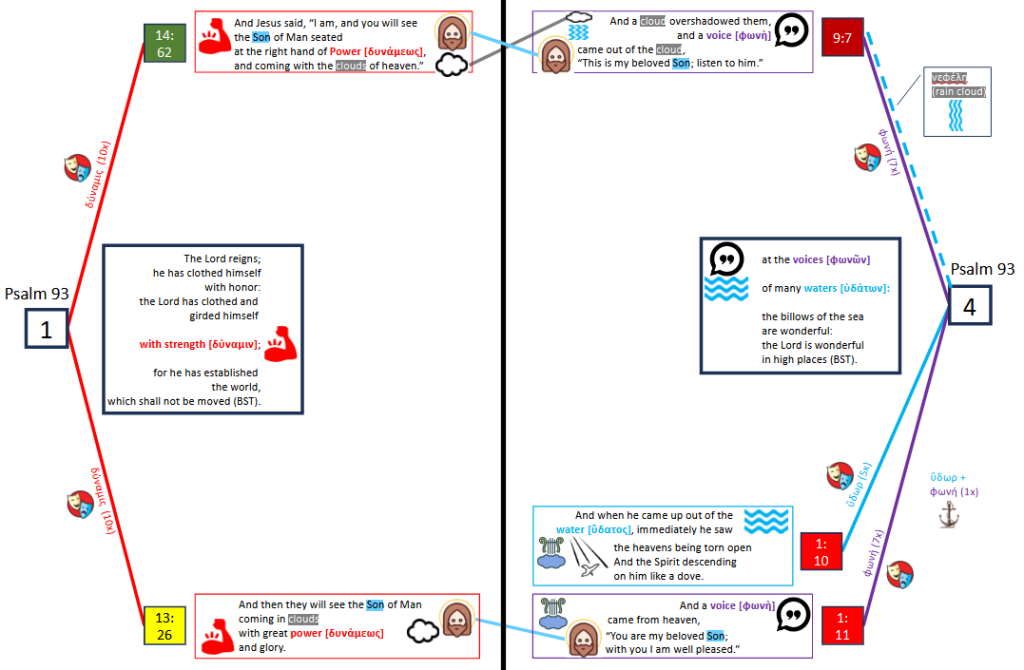
Strength (dunamis), voices (phōnē) and waters (hudatos) are used more than once in Mark’s Gospel (e.g., dunamis 10x), so they are silver anchors. They are clearly thematically linked, as indicated by the theme icons. The combination of voices and waters in Psalm 93:4 come together only once in Mark, in verses 1:10-11, as denoted by a silver anchor. The river, the baptism, the dove, and the voice coalesced into an acted out parable dramatizing the events of Jesus’ death on Good Friday.
Other verses with silver anchors in the above drawing are omitted (why there’s white space) for now so we can focus on the four “corners.” We’ll line up the four corner pieces of Mark’s chiasm with Psalm 93 verses 1 and 4 today, then next time work towards the middle. We already did a deeper dive into the two bottom corners:

To recap, “great power and glory” of the Son’s Second Coming (Mark 13:26) parallel the Son’s first coming at the Jordan River (Mark 1:11). The Holy Spirit is the great power (e.g., Zec 4:6, Lk 24:49, Acts 1:8) who descended as a dove upon Jesus. Peter, who heard the Father’s praise of Jesus repeated on the Mount of Transfiguration, said it was “honor and glory” (2Pe 1:17). So as it will be at Jesus’ Second Coming, it was at His first coming: great power—the Spirit resting as a dove upon Him—and glory—the Father’s vocal praise of Him.
Instead of the bottom two corners, now we’ll be focusing on the two right hand side corners, as the following illustrates:
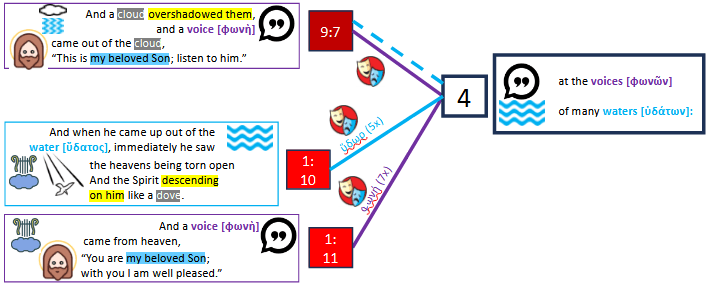
To further summarize where we’ve been, through Mark’s hyperlinking with Psalm 93:4’s “voices” and “waters,” Jesus’ baptism in the river (1:10-11) is brought into alignment with Jesus’ baptism in the cloud (9:7). This hyperlinking makes conspicuous the river and the cloud as “waters.” This cloud, nephelē (nef-el’-ay), on the mountain is a rain cloud (see Lk 12:54, Jdg 5:4, 1Ki 18:45).
In Genesis God separated the waters below from the waters above. Psalm 93:4’s “the voices of many waters” contrast the waters below (the river) and the waters above (the cloud). The waters below are the waters of the Jordan where the Father’s voice was heard. The waters above are the rain cloud from which the Father’s voice came. The voices of many waters then is two-fold: the Father’s voice at the Jordan River and from within the rain cloud.
There’s a qualitative difference between waters below and waters above. The waters below signify death, the waters above, life. Recall how we’d probed Mark’s cosmic cataclysms of Christ’s Second Coming in parallel with the baptism of His first coming:

Pairing “tribulation” with “baptized” highlights this: Jesus’ baptism is tribulation. When Jesus was baptized, it was way more than a ceremony. It symbolized the cosmic-scale tribulation of Jesus’ sufferings from Gethsemane to the cross. Rivers or seas often denote death and judgment.
So with that review, Israel experienced two baptisms: one in water, one in cloud. Paul posited to the Corinthians, “For I do not want you to be unaware, brothers, that our fathers were all under the cloud, and all passed through the sea, and all were baptized into Moses in the cloud and in the sea…” (1Co 10:1-2, emphasis added). Regarding these verses Matthew Henry remarked, “Judaism was Christianity under a veil, wrapt up in types and dark hints.” So Israel’s sea baptism and cloud baptism were “dark hints,” finding ultimate fulfillment in Jesus Christ. The baptism through the waters of the Red (or Reed) Sea foreshadowed the death of the suffering Messiah. And just as Israel experienced a cloud baptism, so did Jesus. The pillar of cloud overshadowing Israel foreshadowed the cloud overshadowing Jesus. To understand what this baptism in cloud meant to Jesus, we first need to see what baptism in water meant to Him. By contrasting these two, we’ll also see their similarities.
Mark highlights Jesus’ baptism taking place at the Jordan River. Although the other Gospels note John the Baptizer’s activity at Jordan, no one is as explicit as Mark as to tie Jesus’ baptism into it. “In those days Jesus came from Nazareth of Galilee and was baptized by John in the Jordan” (Mk 1:9, emphasis added). It’s a significant detail for Mark.
Now, I cannot recall ever researching or hearing what “Jordan” actually means. That was just what it was called. Yes, I’d noted biblically significant events that happened there, but “Jordan River” was just its name, nothing more. Well, the Jordan River means “the descending river.” Jordan is yardēn (yar-dane’ יַרְדֵּן). Yardēn comes from the commonplace verb yāraḏ (yaw-rad’ יָרַד), which means to go down, come down or descend. Why the Jordan River is the Descending River derives from the fact that it descends to the lowest region on planet Earth, the Dead Sea, 1,358 feet below sea level.
Paul picks up this redemptive theme, tying a glorious bow around Jesus’ two baptisms.
Therefore it says, “When he ascended on high he led a host of captives, and he gave gifts to men.” (In saying, “He ascended,” what does it mean but that he had also descended into the lower regions, the earth? He who descended is the one who also ascended far above all the heavens, that he might fill all things.)
Ephesians 4:8-10 ESV
Jesus descended to “the lower regions of the earth,” as many translate it. Some interpret this descent as Jesus’ incarnation, others His descent into hades (1Pe 3:19-20), while others a descent on Pentecost in the Person of the Holy Spirit. The Son of God from the highest heaven to the cross and the grave I would contend is all encapsulated in “He who descended.” This all seems to be hinted at in God’s challenge to apostate King Ahaz: “Ask a sign for yourself from Yahweh your God; make it deep as Sheol or high as heaven” (Isa 7:11). The virgin’s son, Immanuel, fulfilled both! “He who descended is the one who also ascended far above all the heavens, that he might fill all things.”
The word Paul used for “descended,” katabainō (kat-ab-ah’-ee-noh), is how yāraḏ is commonly translated as yāraḏ in the Septuagint. The Yardēn, the Jordan, the descending river, empties into the Dead Sea, the lowest region of the earth. Into this Descending River was Jesus baptized. The ancient Hebrews understood the world in verbs of motion and activity. So the Jordan, Yardēn, dynamically envisions waters that are flowing down, down, down.
Jordan’s deep plunged as low as Sodom and Gomorrah, situated along its banks. “Then Lot lifted up his eyes and saw all the valley of the Jordan, that it was well watered everywhere—this was before Yahweh destroyed Sodom and Gomorrah—like the garden of Yahweh, like the land of Egypt as you go to Zoar” (Gen 13:10). As Lot’s story continues, the judgment motif expands: “And Yahweh rained on Sodom and Gomorrah brimstone and fire from Yahweh out of heaven, and He overthrew those cities, and all the valley, and all the inhabitants of the cities, and what grew on the ground” (Gen 19:24-25). “Brimstone” (or sulfur) is theion (thi’-on θεῖον) in the Septuagint. The fire and brimstone of this judgment are hyperlinked to the final judgment, the second death, “the lake that burns with fire and sulfur [theion]” (Rev 21:8). These infamous Yardēn cities not only expressed God’s wrath against sinners but pointed to the One whose Yardēn baptism included immersion into fire and brimstone, the second death. Heaven’s King “tasted” death for everyone (Heb 2:9), even second death, the death we all deserved.
The Jordan River, then, is a parable told by creation. The contours of Canaan supplied these down, down, down waters to proclaim a bigger story. As sin bearer Jesus had to go down, down, down into death, even second death. Going up and going down throughout the Hebrew Bible convey relational proximity God. That’s another lesson for another day. Going up (e.g., the mountain) conveys relational closeness with God, going down (e.g., to Egypt) relational estrangement. For our punishment Jesus had to hit rock bottom. “My God, My God, why have You forsaken Me?” In the cloud on the mount Father and Son are once again united.
I love Corrie Ten Boom’s saying, “There is no pit so deep that God’s love is not deeper still.” The Descending River carried Love into the deepest pits of humanity’s sin and shame. Christ’s rescue spelunked the deepest trenches of our ocean. Jesus willingly submitted to baptism into the lowest cesspools of our sins so that He could forgive us and then—wonder of wonders—raise us up into the heavenlies into God’s very presence! He loves us that much! Out of incalculable love our Bridegroom descended into the lower regions of the earth to win His beloved bride.
Now let’s contrast Jesus’ water baptism with His baptism in the cloud. “…Our fathers were all under the cloud, and all passed through the sea, and all were baptized into Moses in the cloud and in the sea…” The pillar of cloud that led Israel for forty years through the wilderness functioned in several ways, one being relief from the desert sun. “And the cloud of the Lord was over them by day, whenever they set out from the camp” (Num 10:34). “Your cloud stands over them” for a covering (Num 14:14; Ps 105:39). Shadow or shade is that comfortable, pleasant environment where life—dwelling—happens.
In a previous blog we observed Mark’s Mount of Transfiguration scene hyperlinking to the Mount Sinai scene where the cloudy pillar came to rest on the tabernacle:
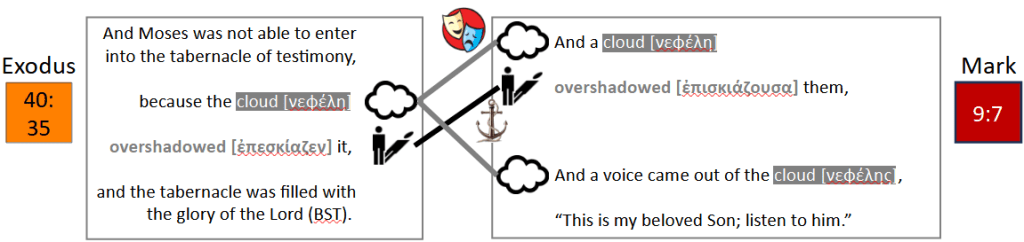
Mark’s episkiazousa (ep-ee-skee-ah’-zoo-sah) silver anchor matches Exodus’ 40:35 Septuagint episkiazen (ep-ee-skee-ah’-zen), together with a matching cloud theme. Epeskiazen is the translation for Hebrew šāḵan (shaw-kan’), “dwelt on.” Other contexts show “overshadow” and “dwell” as interchangeable (e.g. Ezek 17:23, 31:6). David took this a step further:
Be merciful to me, O God, be merciful to me,
for in you my soul takes refuge;
in the shadow of your wings I will take refuge,
till the storms of destruction pass by.
Psalm 57:1 ESV
Line 3’s “in the shadow of your wings” parallels line 2’s “in you.” So taking refuge in the shadow is taking refuge in God. Implication? God’s shadow is synonymous with God Himself! In other words, being enveloped in shadow is to be immersed, baptized, in shadow. That’s why Paul could assert “baptized into Moses in the cloud” when the pillar of cloud overshadowed all Israel. So as Moses led his followers into baptisms of both sea and cloud, so Jesus does for His followers. So what does cloud baptism first mean for Jesus and then for you and me?
Jesus’ cloud baptism, though connected to His water baptism, is qualitatively different. Water baptism descends, cloud baptism ascends. The first broadcasts death and shame, the second life and glory. “Was it not necessary that the Christ should suffer these things [i.e., water baptism] and enter into his glory [i.e., cloud baptism]?” (Lk 24:26). Waters below, the Jordan River, meant unimaginable suffering for Jesus, “the storms of destruction,” in the words of Psalm 57. The waters above, the cloud on the mount, is a “refuge,” a refreshing shade, an unimaginable glory of blessing!
After the water baptism the Spirit as a dove rested upon Jesus. On the mount Jesus rested in the Spirit as a cloud. Jesus rested in the Spirit, symbolized as a cloud, on the mount. Why do I say the Spirit as a cloud? Mark paired up the Spirit as a dove descending on Jesus with the cloud overshadowing Jesus. Implication? The dove and cloud are both expressions of the Spirit! We’d also examined same “overshadowed” language back to when the Spirit overshadowed Mary to yield Jesus in her womb. So the Spirit as dove and cloud correspond to Jesus’ resurrection and ascension. It’s the same Spirit of God but different facets of eternal life.
Mark’s alignment of Jesus’ baptism in the Jordan and the cloud on the mount highlight three phases of Jesus’ humiliation and exaltation. Phase one: He died and was buried. Phase two: on the third day He rose again (resurrection). Phase three: on the fortieth day He rose up to heaven (ascension). These three tiers are vitally important not merely as historical facts but relate to our enjoyment and experience of Jesus and His kingdom.
The River Jordan spelled Jesus’ undoing. It’s death, the unraveling of creation, separation from the Creator. Everything wrong had to be made right. Sin had to be dealt with before a holy God. Jesus’ water baptism prepared the way to undo all that defiled and corrupted to separate us from God. Because we were united with Christ in His death, we can enjoy forgiveness of sins and freedom from bondage. Jesus, the new Adam, reinstated what the old Adam forfeited. The water baptism cleansed us to be welcome back into the garden paradise with God—undoing.
Whereas the Jordan signified undoing, the Dove signified doing. The Spirit as a dove upon Jesus is resurrection life, an anointing marked by doing good and healing all those oppressed by the devil (Acts 10:38). Because of our union with Christ in His resurrection, the same Spirit empowers us to bless others and to testify of God’s goodness to the world. The same Spirit who rested upon Jesus came to rest on the Church on the day of Pentecost. He came as a new power to serve in what Jesus had called them to. The anointing of the Spirit reinstates the original Adam and Eve’s mandate to be fruitful and multiply—doing.
Cloud baptism represents being. It’s the answer to Jesus’ prayer in John 17: that they be with Me and see My glory. When the cloud overshadowed the tabernacle, Moses couldn’t go in. When the cloud overshadowed Jesus the true tabernacle, Peter, James and John had front row seats. It’s just being with God and being enamored with who He is, His glory. The cloud is sabbath, presence, rest—being!
What does it mean to be baptized in the cloud? Just look at Peter, James and John. They were with Jesus; the other nine weren’t. They heard the voice of the Father; the other nine didn’t. They saw Jesus in glory; the other nine didn’t. The cloud homes in on glorying in Jesus only. Not figuring out the mark of the beast. Not sleuthing how national Israel fulfills prophecy. Not evaluating which pastor, podcaster, or preacher is false. Not things related to Jesus but Jesus Himself. “And suddenly, looking around, they no longer saw anyone with them but Jesus only” (Mk 9:8).
Baptism in the cloud is being caught up with Father, Son and Spirit, not out and about doing something for God. “No longer do I call you slaves, for the slave does not know what his master is doing; but I have called you friends, for all things that I have heard from My Father I have made known to you” (Jn 15:15). Friendship is hanging out with Jesus and listening to Him (“Hear Him”). Mary chose the better part. It’s voluntary. Jesus has opened wide the door but you choose whether you go in or not.
The pillar of cloud didn’t rain on Israel, but Jesus’ cloud does. It’s a superior spiritual rain. The words of Jesus rain upon our thirsty souls like showers upon the earth, as Isaiah says, to “accomplish that which I purpose, and shall succeed in the thing for which I sent it” (Isa 55:11). What gets done? “For you will go out with gladness and be led forth with peace” (verse 12). These showers from the clouds produce a bountiful harvest of peace and joy in our hearts. This is what life is like overshadowed by the cloud, living in the Spirit.
Do you ask for the Spirit just to enjoy God? Loving God is the first and greatest commandment. There’s no guilt of asking for the Spirit just to witness Him. The Holy Spirit frees us up to see the glory of Jesus when we examine Scripture. Earlier on in my Christian life I felt guilty asking for the Spirit if it wasn’t for the purpose of serving people. But the baptism of the cloud freely invites me into sabbath rest, a ceasing from my own labors, into a fellowship and friendship with the living God! Do you ask for the Spirit just to enjoy God? If you don’t, give it a try!
Now, how you personally apply truth is a matter of conscience before the Lord. For me, expressing my faith in these wonderful truths with simple prayers have been very life impacting and transformative. I like to sometimes turn nouns into verbs (horrible English grammar, I know), but I can say a lot with a little that way. “Fountain me with Your living waters.” “Cloud me with Your Spirit.” Then I trust and expect Him to do it. And He does! Day after day.
Great is Thy faithfulness, O God My Father,
There is no shadow of turning with Thee.
All I have needed Thy hand has provided;
Great is Thy faithfulness, Lord, unto me.
 Glory Unveiled: Discovering Jesus