I love how the Gospel of Mark ushers us into the breathtaking wonder of our three-in-one God! I suspect you will be surprised by the Trinity that Mark unveils in a night vision of the prophet Zechariah through his storyline of Jesus Christ. (I give credit to pastor and author Jamey Miller, whose excellent book Surprised by the Trinity inspired not only the title of this blog but prompted me to write it.) My total absorption in this Gospel daily for the last year and a half, this consuming passion to explore Jesus, is why I put blogging on pause for the last ten months. Today I break that silence.
If you’re familiar with The Bible Project, you’re aware of the fantastic way they take the stuff of ivory tower theologians and make it very accessible to the average Christian. They educate us on tried-and-true techniques that the Hebrew Bible authors used to creatively connect the dots between many passages. Well, Mark, after the literary traditions of these biblical authors, likewise uses “scroll technology” to link up the testimony of Jesus to many Old Testament passages. The difference I’ve observed, though, is that Mark takes it to a whole new level, super creative in his expression of it! Why wouldn’t he? After all, this endeavor wasn’t for just anybody; it was for Jesus Christ, the Son of God, the blessed Creator and God over all!
What’s been so surprising to me is how marvelous is his ability (by the Holy Spirit, of course) to have crafted his Gospel in this way. I’ve observed him do these literary links in all sixteen chapters and never fail to be amazed at God in how he does them. “The testimony of Jesus is the spirit of prophecy” (Rev 19:10). What Mark does is takes the testimony of Jesus and connect it so as to give breath (spirit) to these ancient prophecies. They come alive! As James says, the body without the spirit is dead, Old Testament prophecy is “dead” without the testimony of Jesus. I think that’s why so often the Old Testament feels dead to us. It’s missing something. It’s the testimony of Jesus. Fortunately, Mark gives us this in his unique way of doing Bible commentary. Over the decades I’ve read and profited from many excellent Bible commentators—Matthew Henry, Jameson, Faucet & Brown, Charles Spurgeon, David Guzik, and many, many others. But Mark has become my all time favorite Bible commentator.
Though I don’t have perfect understanding of everything I’ve studied in Mark’s Gospel (far from it!), what has been clear has powerfully ushered me into the heart and mind of God. My prayer life has been radically altered in some cases. Entering into Mark’s Bible commentary reminds me of the movie scene of C. S. Lewis’ Voyage of the Dawn Treader where the sea in the painting on the wall starts flooding the room, sweeping the characters from humdrum England into fantastic Narnia. In this spirit I hope you may be swept up into the beauty of this three-in-one God as Mark lays it out in Zechariah 3.
Mark has his eye all over Zechariah 3 (as well as chapters 2, 4, 5 and others that I’ve observed so far). There’s so much to see just in Zechariah 3, but to do so would be overwhelming. Sensory overload. So we’ll set aside a boatload of literary links in here to zoom into just the Father, Son and Spirit in this sublime cosmic courtroom scene in verses 1-7. The prophet’s night vision is given in parable form. Without the key to the parable, though, it’s hard to figure out what’s really going on. Fortunately for us, Mark gives the key to it in the testimony of Jesus found in chapter 15 of his Gospel. Here are the first links that help us discover place and people:
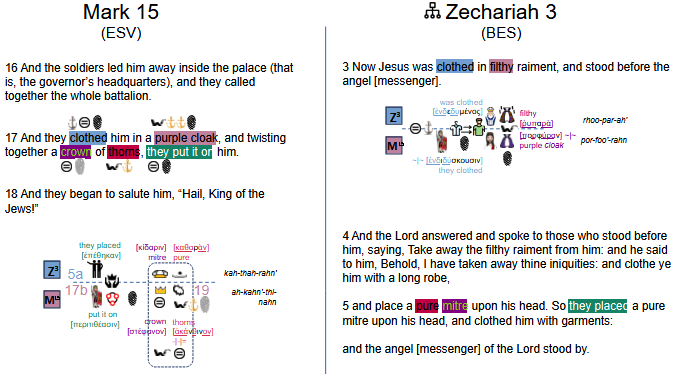
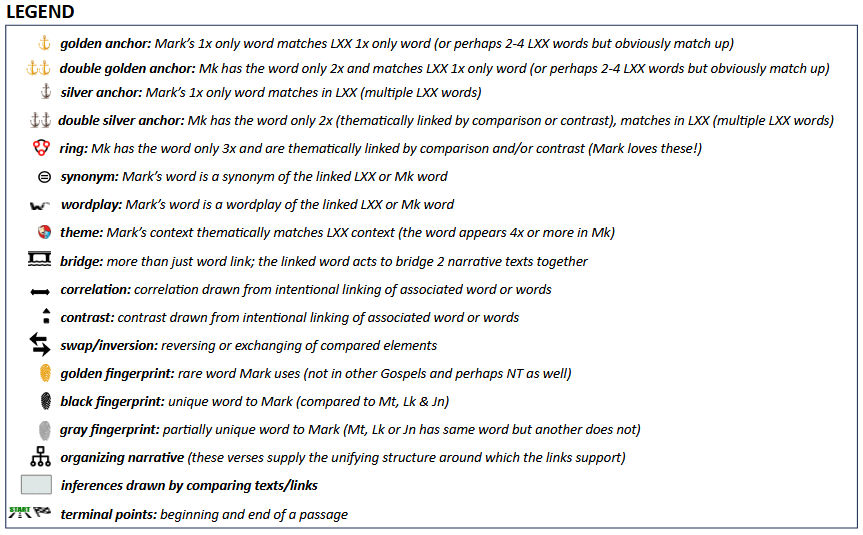
See “purple cloak” highlighted in Mk 15:17? The light purple highlight there matches up with “filthy” in Zec 3:3. It’s got that funny “W” icon for wordplay. (I have a legend for all these icons at the end). This means Mark used a play on words (a pun) to create a literary link here. The diagram under Zec 3:3 shows the Greek wordplays with the pronunciations: por-foo’-ran (purple cloak) with rhoo-par-ah’ (filthy). Usually five or more letters match between the two words to be an obvious wordplay. Although this is commonplace among the Bible authors, the average Christian probably isn’t so well acquainted with them (I know I wasn’t until the last year or two). What this does is link the purple cloak to the filthy clothes worn by the high priest Joshua (“Jesus” per the Brenton English Septuagint [BES] translation because in Greek it’s the same name). Here’s a big clue to our Zechariah parable: Joshua wearing the filthy clothes links to Jesus wearing the purple cloak!
The icons to the right of the “W” icon are icons that convey intentionality. Did Mark really intend to link these? These icons identify rarity that suggest purposeful selection. The double gold anchor means Mark used this word only twice (the other comes in verse 20) and matches to the word that appears only once or twice in the Septuagint (here it’s twice: Zec 3:3 and 4).
The black fingerprint is comparing Mark’s version of this (i.e., the soldiers and the crown of thorns scene) against the same scene in the other gospels. Since Matthew and John don’t use this word (Luke doesn’t mention this scene), it’s a black fingerprint, meaning it’s unique to Mark. In other words, Mark specifically chose this rare word to sync up (via a wordplay) to this rare word in Zechariah.
Now look at “thorns” highlighted in Mk 15:17; it’s magenta highlight partner appears as “pure” in Zec 3:5. The “W” icon indicates it too is a wordplay, which is illustrated underneath Mark 15:18. Thorns (“ah-kahn’-thi-nahn”) mimics pure (“kah-thah-rahn’”). It has a golden anchor of laser focused intentionality likewise bridging these two scenes together. Here’s another clue to the parable: Joshua’s pure mitre is depicting (in parable form) the crown of thorns on Jesus’ head!
“Crown” here shows an icon with an “=” inside a circle, a synonym. The mitre displays the “holy crown” (Ex 29:6). The high priest’s mitre is synonymous with a crown. Word links “clothed” and “they put it on” are likewise synonyms. These two scenes coalesce by two rare word links (golden anchors) and synonyms that mirror the actions of Zechariah’s vision with the actions of the Roman soldiers and Jesus. Zechariah actually provides a bit of explanation as to the meaning of the filthy garments:
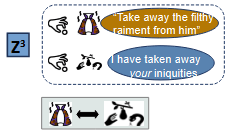
Jesus stood in our place as a substitute for us as sinners. So Jesus wearing the filthy clothes portrayed the spiritual reality of Him “wearing” our sins and iniquities. The good news if that Jesus succeeded in taking away our iniquities!
Now let’s look at the second half of Mark’s Roman soldiers scene:
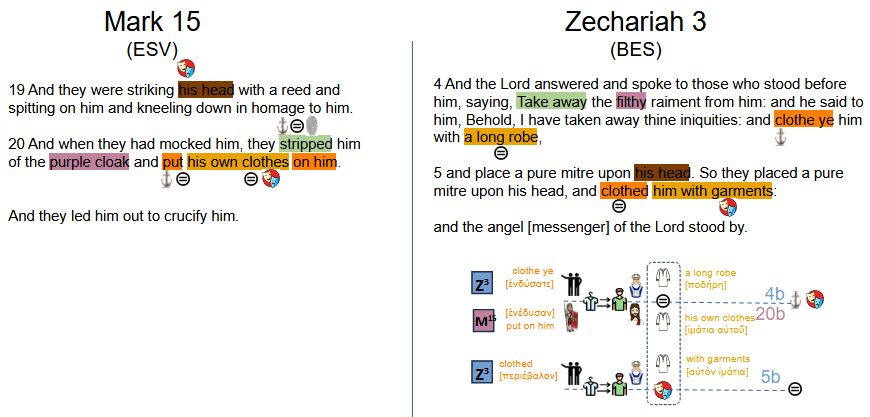
The “his head” in Mk 15:19 matches up with “his head” in Zec 3:5. The theater icon is a theme (i.e., “head” is a common word in Mark’s gospel that thematically matches with Joshua’s head here). I’m not 100% clear about the linking of the soldiers striking with the placing of the pure mitre. It makes logical sense but departs from chronological sequence. But I think it at least means this: the blows that drew our Savior’s blood here corresponds to the purity of that mitre (and a purity that gets transmitted through faith to us by God’s grace!).
The purple cloak/filthy raiment that had been worn in Scene 1 are now removed here in Scene 2. They “stripped” the purple cloak syncs up as a synonym to “Take away” the filthy raiment. You can also observe the similarities (synonyms) of putting on Jesus’ clothes before He went to the crucifixion. “Those who stood before him” (Zec 3:4) were the Roman soldiers. The messenger of the Lord commanded them to remove the filthy clothes, so they, like the great fish (or whale) that swallowed Jonah, unconsciously obeyed: “they stripped him of the purple cloak.” God is in control, not the soldiers!
Okay, now is where it gets exciting seeing the Trinity! We return to the beginning of Zechariah 3:
1 And the Lord shewed me Jesus the high priest standing before the angel [messenger] of the Lord, and the Devil stood on his right hand to resist him. And the Lord said to the Devil,
2 The Lord rebuke thee, O Devil, even the Lord that has chosen Jerusalem rebuke thee: behold! is not this as a brand plucked from the fire?
We know now who Joshua the high priest is: it is Jesus! This is a great help because I have had it ingrained in my head through much study that the angel of the Lord often times is a pre-incarnate appearance of Jesus as God the Son. That bias (a good one) has led me to see Joshua the high priest as someone other than Jesus since the angel of the Lord had to have been Jesus (or technically, God the Son). Here, though, by Mark’s literary links we have an exception to the rule of the angel of the Lord being Jesus. Who could it be then?
Before we go on, I want to get this off my chest. “Angel” is not an ideal translation. The word in both Hebrew and Greek simply means “messenger.” The Hebrew language especially focuses on function more so than appearance. This messenger of the Lord has to do with purpose or function, not a visualization of some heavenly species that flies around with wings. The context of the biblical passage determines who the messenger is, whether a human courier, cherubim, or Yahweh Himself. So from here on, I will be using “messenger” rather than “angel” to disentangle our cherubim bias so as to be more like how the original readers would have comprehended the text.
There’s a messenger of Yahweh/Yahweh combo here that is God’s hinting to His people a category for knowing Him as Trinity. (The Bible Project “God” podcast series of about 20 sessions develops this wonderfully through the Hebrew Bible into the New Testament). Moses at the burning bush encountered the messenger of Yahweh who we discover also is Yahweh. So the messenger (pre-incarnate Jesus) is the messenger of Yahweh (not Yahweh) yet surprisingly also is Yahweh. Baffling and mysterious, yes. But thinking about the Trinity is that way, after all. These mysteries happen elsewhere like with Gideon and the messenger of Yahweh. Anyway, all that to say that Zec 3:1 points out the messenger of the Lord standing before Jesus is also Yahweh, for immediately it says, “And the Lord [not messenger of the Lord] said to the Devil…” This happens not just once but twice. Verse 3 says, “Jesus…stood before the messenger,” followed by verse 4: “And the Lord answered and spoke…” This familiar pattern threaded through the Hebrew Scriptures is hinting once again to the identity of this messenger as Yahweh Himself, one of the members of the Trinity.
Since this messenger isn’t Jesus, there’s only candidate left for being a sent one in the Trinity. It’s the Holy Spirit! Though the Spirit is not explicitly called by name “the messenger of the Lord” anywhere in the Bible (that I’m aware of), He most definitely is in function. The Gospel of John alone has numerous references to the Spirit being One sent from Father and Son to convey messages (e.g., He will remind you of everything I have told you, He will lead you into all truth).
Now let’s circle back to the first verse:
And the Lord shewed me Jesus the high priest standing before the [messenger] of the Lord, and the Devil stood on his right hand to resist him. And the Lord said to the Devil,
That leaves this phrase to examine: “And the Lord shewed me Jesus…” There’s the Father! Although Jesus is most naturally wears the title “Lord,” it’s not an exclusive title, depending on context. I cite just one example: “In that same hour he rejoiced in the Holy Spirit and said, “I thank you, Father, Lord of heaven and earth, that you have hidden these things from the wise and understanding and revealed them to little children; yes, Father, for such was your gracious will” (Lk 10:21). The Father is spoken of here as “Lord” and also as One who reveals Jesus (i.e., the Father and Son mutually revealing each other [see verses 22-24]). Now that you have the main characters identified, read, study and meditate on this passage, consciously depending on the Spirit of truth to give you understanding. Read Zechariah 3 with fresh eyes and see what you can discover!
Here’s one last look at Mark’s links that open up this especially wonderfully to my heart. This vision has radically altered the way I pray for others.
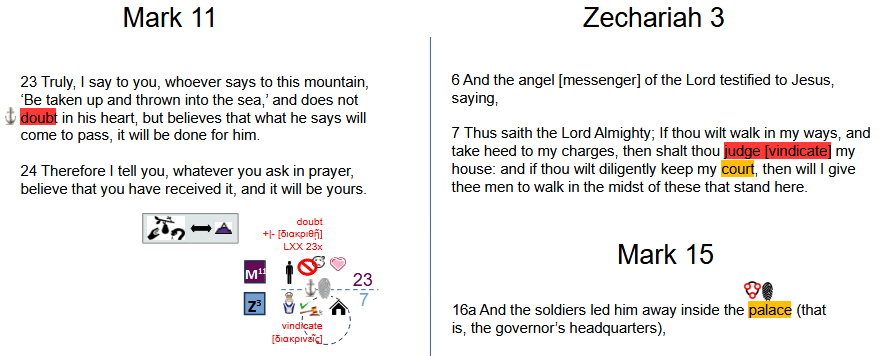
The silver anchor of red highlighted “doubt” indicates that word Mark uses only one time and there are multiple instances of it in the Septuagint. I must confess that “doubt” and “judge [vindicate]” has been challenging to get my head around. But in meditating on the Mark 11 context, removing a mountain (which happens, by the way, not coincidentally in Zec 4) is an alternate way of thinking about removing our sins (mountainous!) as depicted in the filthy garment removed from Joshua the high priest. That’s why I have “[vindicate]” rather than “judge” as it fits with God’s house—His people—being vindicated from their sins (i.e., mountain moved, filthy garments removed). The Hebrew word here can mean judge or vindicate; the context of the passage determines which one. For instance, in Genesis 30:6 Rachel said, “God has judged me,” by blessing her with a son, Dan. Her context means that God vindicated her, not judged her in a condemnatory way.
The author of Hebrews wrote of the Spirit, “how much more will the blood of Christ, who through the eternal Spirit offered himself without blemish to God, purify our conscience from dead works to serve the living God” (9:14). I’d wondered how the author knew this. Was it a special revelation he got? Or was it derived from the Old Testament? Now I am persuaded that it’s in reference to this Zechariah 3 passage! Now, there may be other passages he had in mind that I’m not aware of, but it at least includes this one. The eternal Spirit was actively involved. He is said to have been “standing by” (verse 5), which in priestly terms means working. The priests did not have a place to sit down because they were always working. The Spirit as the messenger of Yahweh was actively working in directing the removing of our filthy garments and the placing of the clean turban on our head, a purification of our conscience from dead works.
Notice, too, how this is happening in a “court” (same Greek word translated as “palace”) as per the links. So while the Roman soldiers were beating and bloodying Jesus in Pilate’s court, behind the scenes is this very holy interaction going on between the Spirit and the Son in the Father’s court. Heaven and earth overlap.
The Spirit pledged to give the Son “men to walk in the midst of these that stand here.” Again, those that “stand here” are those malefactors, the Roman soldiers, and by extension, you and me who have participated in the spirit of these same sins. The BES translation isn’t as good as the original Hebrew. I cut them some slack because it is a difficult thought to convey. What the Spirit promised Jesus was a one-of-a-kind word that means “walkings” (the common verb for walk prefixed with an “m”, which makes it a noun-—mahălāḵim [mah-hah’-lah-keem]). It’s only used here in the whole Hebrew Bible. It kind of means walking paths. Because Jesus did not doubt in His heart what the Spirit told Him while the soldiers (and the Devil accusing right in their midst) unleashed their best torment, by faith He triumphed and vindicated God’s house, the church! Now the Spirit makes good on His promise to Jesus to give Him access to those who beat and bloodied Him—literally those Roman troops and figuratively us. I believe the centurion (who was in charge of this battalion) later in Mark 15 is the first fruits of this Spirit-to-Jesus promise being fulfilled.
“Walkings” is a restoration of what was lost in Eden when Yahweh used to come walking with Adam and Eve. Jesus walks with us again like the old Garden of Eden days (of course, after a spiritual manner). I like to pray for the Spirit to make good on His promise to Jesus for mahălāḵim. I have typically thought of us drawing close to the Lord. But this divine insight powerfully shows a promise of Jesus drawing near to His people, walking with them as in the opening scenes of Genesis and so many scenes in the Gospels. This same concept also occurs in the end of the Bible. “Thus says the one…who walks among the seven golden lampstands [the churches]” (Rev 2:1). My faith has confidence God will answer my prayers to open up fresh pathways of relational intimacy with whoever brothers and sisters (or sometimes whole churches) in Christ I’m interceding for. This Zechariah vision makes so clear His willingness to do this.
Anyway, I know that’s a lot but I hope it opens up some fresh thinking on old passage to see our awesome three-in-one God actively engaged in the most difficult of all rescue missions to save us—all because He loves us! Wonder of wonders!
P.S. As mentioned above, here are the icons with explanations:
 Glory Unveiled: Discovering Jesus