As the time approached for Jesus to go to the cross, His disciples asked Him, “Where do you want us to go and prepare the Passover so that you may eat it?” In response, Jesus instructed them, “Go into the city, and a man carrying a jar of water will meet you. Follow him. Wherever he enters, tell the owner of the house, ‘The Teacher says, “Where is my guest room where I man eat the Passover with my disciples” (14:13-14 CSB). Who is this mystery man?
I’d always thought that this exhibited Jesus’ omniscience, a gift of the Spirit, the word of knowledge in operation. It certainly is that. But Mark’s hyperlinking to two key passages in the Old Testament shed a whole flood of light on the meaning of the man, the jar, and the water that I never knew existed! It’s so amazingly captivating! So buckle up and fasten your seat belt; we’re going for a ride into Mark’s wonderful world of drawing correlations from the Hebrew Scriptures that illumine his narrative storyline with iridescent colors.
One thing I’ve observed about Mark’s Gospel is that no detail, however small or minute, is without significance. These bit players who rise meteorically across his narrative sky and then disappear just as quickly are rippling with relevance to our faith in Jesus. Understanding this is not about head knowledge. Mark is after the purity of our hearts toward God and man. Most of all he wants us to train our eye on this glorious Jesus, the hero of his Gospel. As we gaze upon Jesus’ glory by the Spirit, we are changed into that same image from glory to glory (2Co 3:18).
Jesus often taught parables. We’re very familiar with these, such as the good Samaritan and the prodigal son. But Jesus also presented “live action” parables. These we’re not so acquainted with. The man carrying a jar of water is a parable on legs, a parable acted out in real life before the disciples’ eyes. As we puzzle over parables, we gain precious insight as the Spirit brings clarity to our seeking hearts.
Our first literary link has to do with the jar (or pitcher). It’s the Greek word keramion, only here in Mark and just three times in the LXX (Septuagint), the authorized Greek translation of the Hebrew Scriptures. This link is what I call a gold anchor, where Mark’s one-time used word has only one or a couple of instances of the same word in the LXX. Gold indicates the highest degree of intentionality on Mark’s part to single out this place in the Old Testament. Keramion links with Isaiah 30:13. How do we know it’s this one as opposed to the other two keramion references? It’s corroborated by numerous other hyperlinks, matching themes, and validating symmetries within the Isaiah 30 context.
We’ll just dive right into the ongoing flow of events in Isaiah to zero in on this gold anchor linkage:
“Therefore thus says the Holy One of Israel, Because you have refused to obey these words, and have trusted in falsehood; and because you have murmured, and been confident in this respect: therefore shall this sin be to you as a wall suddenly falling when a strong city has been taken, of which the fall is very near at hand. And the fall thereof shall be as the breaking of an earthen vessel, as small fragments of a pitcher [keramion], so that you should not find among them a sherd, with which you might take up fire, and with which you should draw a little water” (Isa 30:12-14 BES, edited for modern English). The BES (Brenton English Septuagint) is an English translation of the Greek Septuagint, particularly helpful when examining Mark’s Greek word links to this Greek-based text.
The following illustrates the gold anchor (see the light green rectangle) and some other relevant hyperlinks. I include this detail-rich presentation for your own study and meditation.
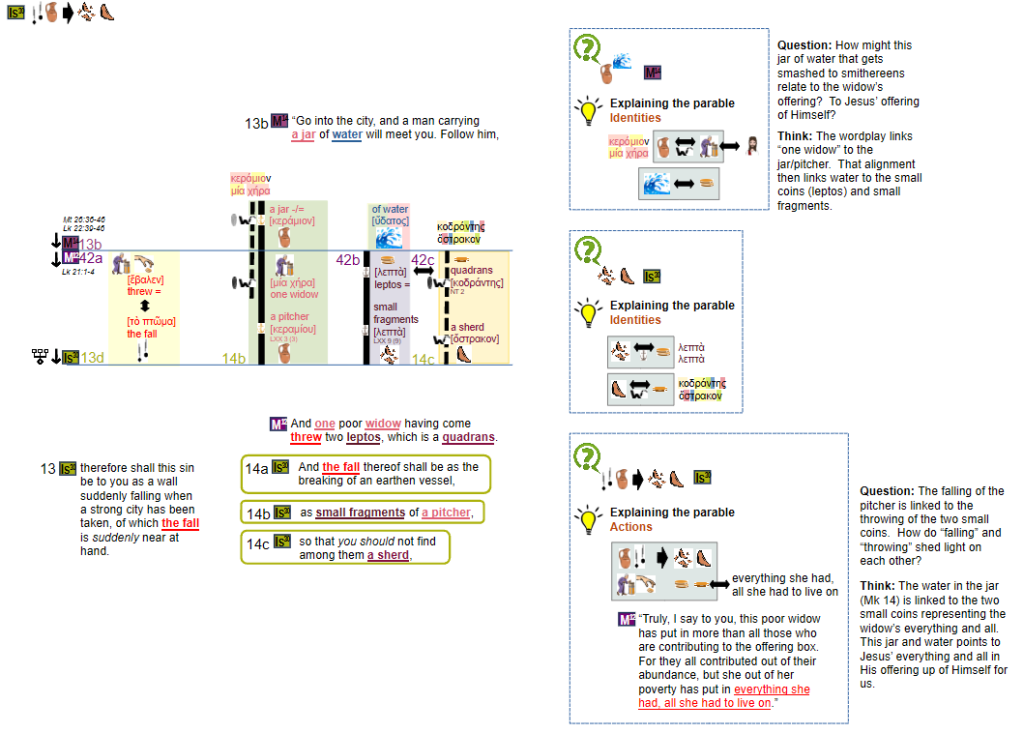
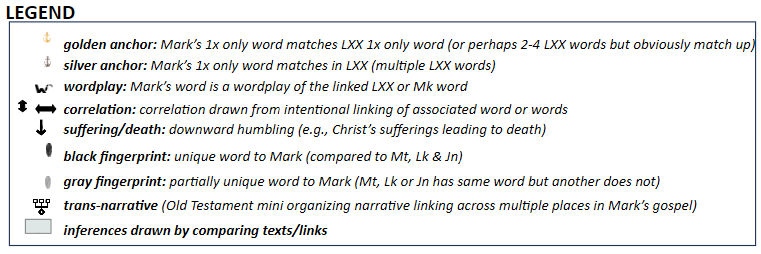
You’ll notice that in addition to Mark 14’s jar of water that the widow of Mark 12:42 is also included. That’s because the Isaiah 30 passage has two key links to it besides the gold anchor to the jar. The two mites, as King James Version phrases it, are small copper coins, the lowest denomination at the time akin to today’s pennies in the U.S. The word for mites is leptos, its one-time use in Mark comprising a silver anchor to the small fragments [leptos] of Isaiah 30’s pitcher shattered from its fall. Mark’s unique use of “quadrans” (of Latin origin, another way to refer to these coins) forms a wordplay link to “sherd” in Isaiah. If that weren’t enough, Mark does a clever wordplay between “one widow” and “jar” of Mark 14.
Rather than me spending a lot of time explaining, I thought it might be more profitable to the reader to pose questions in the diagram for further reflection. Please look again at the diagram and take some time to read the questions and ponder them. Invite the Holy Spirit to lead your mind into its truth.
So our big takeaways are that the jar of water on the man’s shoulder is the smashed pitcher of Isaiah 30. Our following of the man is a following into Isaiah 30’s vivid scene to a future time when this pitcher would be so ruthlessly smashed that not even a tiny shard would be big enough to collect any water. Without digressing too much, the immediate context of Isaiah 30 is God’s punishment of the people’s sins executed as thoroughly as a shattered pitcher. What’s cool is that this national judgment provides a framework for envisioning the greater judgment—Jesus, the sin bearer of Isaiah 53, experiencing the wrath that the people’s sins deserved. Even in wrath God remembers mercy in Jesus!
Furthermore, the falling of the pitcher is connected to the falling of the tiny coins thrown by the poor widow into the temple treasury. In seeing the widow’s gift, Jesus saw His own gift to come. We’ll tie these more together as we get into the second golden anchor link. As an aside, Mark’s linking of the jar and pitcher to Isaiah 30 is only the beginning of many amazing links to various parts of his Gospel, stretching from verse 13 of Isaiah 30 here all the way through verse 26. This is but the first glimpse into an underwater aquarium of beautiful colored fish and corals.
“Go into the city, and a man carrying [bastazōn] a jar of water will meet you. Follow him.” Now we will examine carrying, bastazōn. This word is only used once in Mark and it appears only twice in the LXX, making it another gold anchor. By the way, having two gold anchors in the same passage is a rare occurrence in Mark’s Gospel. It obviously connects to this scene in 2 Kings 18 (see the light green rectangle for the gold anchors):
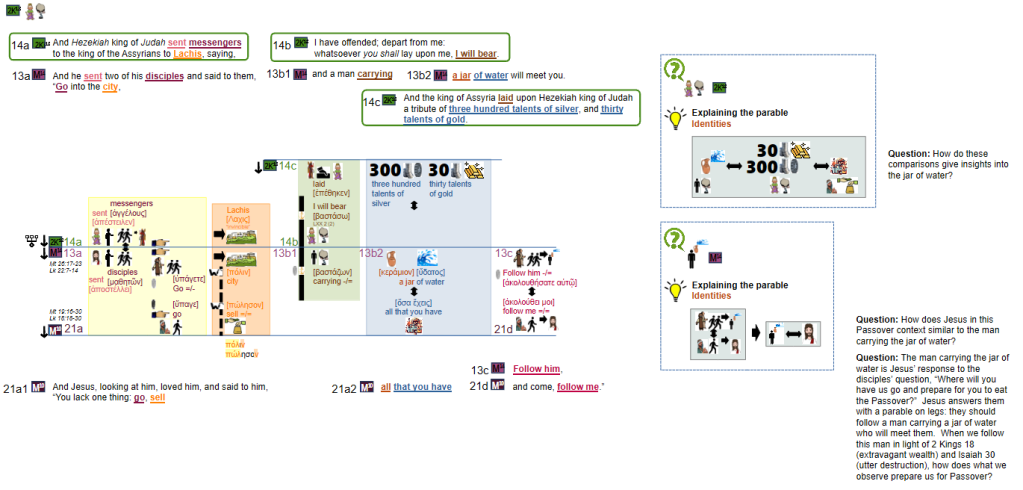
You’ll notice that in addition to Mark 14 that the rich young ruler of Mark 10:21 is in the mix. This is because it has three key links to Mark 14 above and beyond the thematic similarities of Jesus sending disciples into the city and King Hezekiah sending messengers into the city. They both feature the “go” command, a wordplay linking “city” and “sell,” and the “follow” command. The “follow” command is what unmasks the man carrying the jar as a foreshadowing of the man Jesus!
Now, by way of a brief backstory, King Hezekiah, one of Judah’s few good kings, had gotten himself into trouble with the Assyrian superpower. Early on he’d rebelled against the king of Assyria (2Ki 18:7). The king eventually responded by capturing all the fortifies cities of Judah except for Jerusalem (verse 13). “And Hezekiah king of Judah sent messengers to the king of the Assyrians to Lachish, saying, I have offended; depart from me: whatsoever you shall lay upon me, I will bear [bastasō]” (verse 14 BES, edited for modern English).
What did King Hezekiah bear? That is answered in the next two sentences:
“And the king of Assyria laid upon Hezekiah king of Judah a tribute of three hundred talents of silver, and thirty talents of gold. And Hezekiah gave all the silver that was found in the house of the Lord, and in the treasures of the king’s house” (BES, edited for modern English). So we’re to see that the jar of water that the man is bearing has a parallel with the 300 talents of silver and 30 talents of gold, an enormous amount, that the king is bearing. Again, more explanation can be obtained by revisiting the diagram. I encourage you to pause to think about the questions.
Our big takeaway from 2 Kings 18 is that the man carrying the jar of water on his shoulder is a rich king—King Jesus! The poverty-stricken widow giving all she had to live on is complemented by the rich king who gave all the wealth in the temple and his royal house, as we’ll see shortly. The bearing of the jar of water has parallels to the paying of a tribute of unimaginable wealth. This is our Jesus whose love suffered to pay the highest price for His beloved bride. This costliness points out how much He loves you and how much He loves me.
We will now take a closer look at the 300 talents of silver and the 30 talents of gold to wrap up our exposition of the live action parable of the man carrying the jar of water. First, the 300 talents of silver. The man carrying the jar of water and the rich young ruler of Mark 10 still hang around, but the unique literary linking to “300” includes the alabaster jar of expensive perfume of Mark 14 estimated to be over “300” denarii, about a year’s wages. Mark doesn’t name the woman who broke the alabaster jar, but we know from John’s parallel account that this is Mary of Bethany. Observe the silver anchor links between the three hundred of Hezekiah’s silver debt and the three hundred of the estimated worth of Mary’s alabaster jar (see the top light blue rectangle):
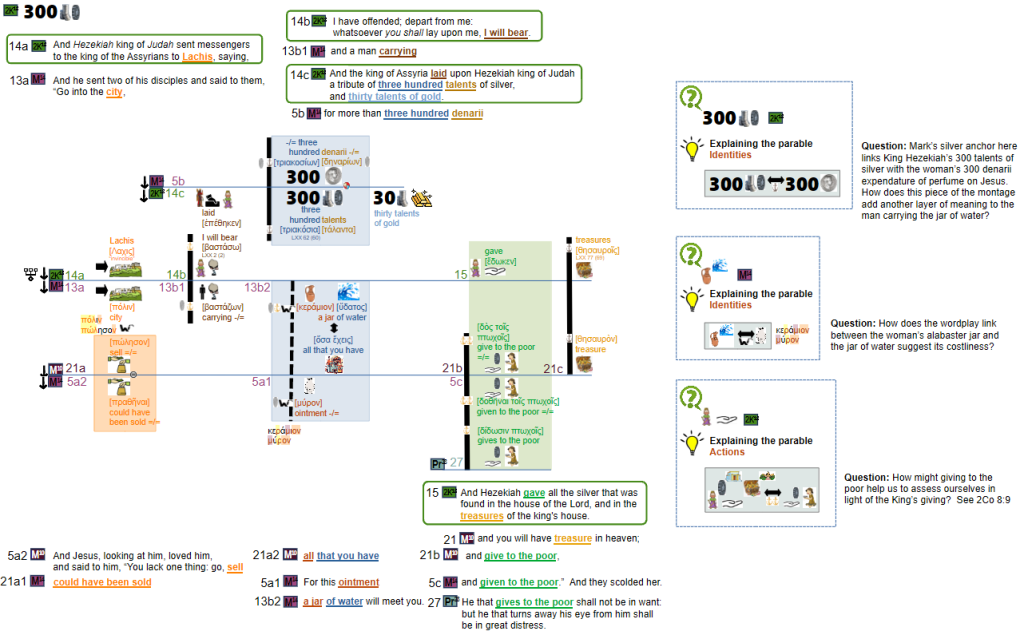
Please consider the questions above to help gain fresh insight into the costliness of Jesus’ offering up of Himself as the Passover lamb.
Our big takeaway from the 2 Kings 18’s three hundred talents of silver is that it’s “all the silver that was found in the house of the Lord.” Jesus’ giving comprised all that which the silver, a symbol of redemption or purchase, that the temple depicted in shadow form.
Our final peek into the costliness of this Passover offering is the 30 talents of gold. Take a look at this diagram that shows Mark’s hyperlinking in this context (see the light blue rectangle for the silver anchor links with “30”):
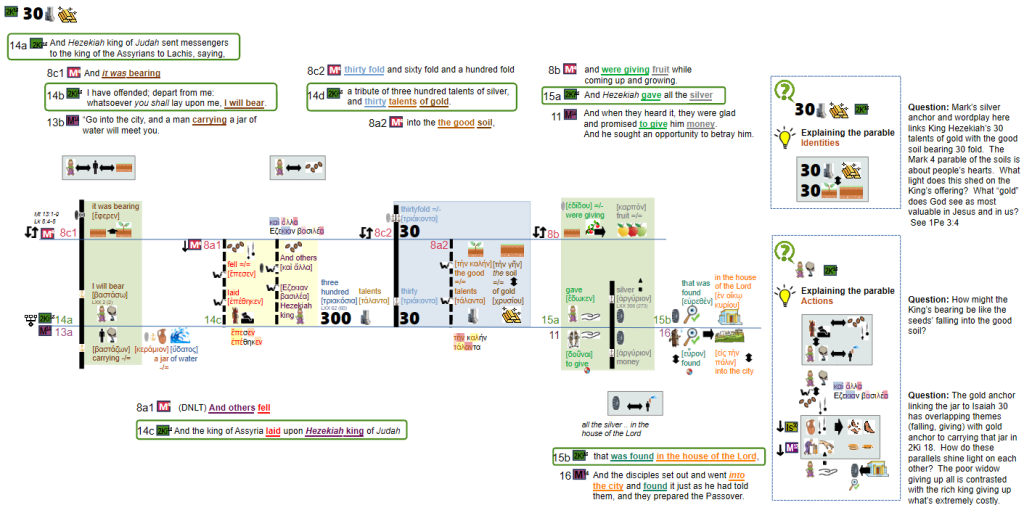
What’s new here is the addition of the parable of the soils in Mark 4. The “thirty” of the thirty talents of gold has a silver anchor link to the “thirty” fold fruitfulness of the seeds sown into the good soil. The bearing of the good soil (leftmost light green rectangle) is a synonym of bearing and carrying. Mark does an extremely clever wordplay with “And others” and “Hezekiah king” (light yellow rectangle). Matthew’s and Luke’s versions of this parable do not leverage the phrase “and others” for this wordplay. There’s a second wordplay with “the good” and “talents” (light blue rectangle). The giving of fruit also matches thematically with Hezekiah’s giving the silver and gold and the chief priests’ giving money to Judas Iscariot to betray Jesus (rightmost light green rectangle). Now, please check out the questions in the diagram for more insights.
Our big takeaway from the 2 Kings 18’s thirty talents of gold, the most precious treasure, has to do with the heart. Jesus had a heart of gold in His Father’s eyes. What’s gold about us to God is our hearts. This montage has a mix of suffering (the down arrow icons) and glory (the reversal arrows icon). King Jesus was like seeds that fell into ground and died. After He was raised to life, He now perpetually gives fruit to His beloved bride. It’s the Garden of Eden all over again!
A lot more can be said, not to mention the overarching picture of beautiful symmetries that has taken my breath away. Lord willing, I will share more of these insights into the heart and mind of God. I am learning to track with Mark in his masterful use of the montage. A montage is a collection of smaller scenes that all taken together tell a bigger story. If you’re familiar with the Avengers Marvel movies, a good example of a montage is the opener where each superhero is seen in action within each letter of Marvel (e.g., “M”, “A”, “R”), showcasing each individual that taken together communicates the whole team. Similar to today’s cinematography, Mark is an expert with the medium of words, highlighting his superhero, Jesus. At the heart of this montage is a gathering up of action-packed scenes from the Old Testament and his own Gospel to produce a composite sense of what the man carrying the jar of water really means. Isaiah 30 visualizes the jar falling and being smashed to smithereens. The poor widow throwing her two mites envisions sacrificing everything. 2 Kings 18 activates King Hezekiah bearing a ginormous costly payment of silver and gold. Mary of Bethany’s broken alabaster jar accentuates costliness from yet another angle. Though the rich young ruler walked sadly away, Jesus did sell all He had to give to the poor. And those seeds falling into the good soil would live again keep on giving fruit. Meditate on each scene and see what that does for your faith and love for the Lord.
The jar and its water represent Jesus giving Himself as the Passover lamb and what was most precious to Him—God. That’s part of the reason He cried out, “My God, My God, why have You forsaken Me.” He was shattered so thoroughly that not a shard could be found to contain even a drop of water—the Living waters of God’s presence.
“Where do you want us to go and prepare the Passover so that you may eat it?” Where? God is more concerned with heart geography. Where is my heart—near God or far from Him? Your heart is God’s gold. He desires your heart most of all. May these studies and meditations bless you in preparing your heart to see the fall that broke Jesus into smithereens to pay for your sins and the unsearchable riches He recklessly spent to purchase you. “Go into the city, and a man carrying a jar of water will meet you.” Follow Him!
 Glory Unveiled: Discovering Jesus
One thought on “The Man Carrying the Jar of Water Explained!”