Do you feel your relationship with God is often dry and distant? Perhaps it’s been that way for a long time. Are you saddened and discouraged by the dryness all around at your church? Do you pray for revival? I have good news for you today from the prophet Isaiah: because of Jesus’ death, God has opened up once again the flowing waters of Eden again. Not just sporadic, occasional spurts. Flowing waters—continuously, like a river full of water. This abundance is not just for an few elite supersaints. It’s for everybody. It’s not just for churches that say they’re “Spirit filled” or name-branded by obvious biblical allusions to the Holy Spirit. This abundance is for all churches, great and small, that are united to Jesus Christ by faith. Let’s take a deeper dive into the gospel presented in Isaiah 30, viewing it like Mark wants us to through the lens of the man carrying the pitcher of water.
The following picture is a partial visualization of how the Gospel of Mark interacts with the text of Isaiah 30. Mark’s astute linking of specific words piggybacks off of an already established pairing up of verses within Isaiah 30, contrasting the breaking of an earthen vessel in verse 14 with the immoveable mountains and hills of verse 25. The common denominator between verses 14 and 25 is water. What makes a clear connection is the gold anchor between the jar of Mark 14:13 to the pitcher of Isaiah 30:14. As I’ve worked through the text, other passages of Mark in chapters 4, 9 and 16 also emerge as shown.


Now, looking at the above picture is a bit busy and somewhat challenging to figure out where Mark is going with it. I’ve isolated a section so you can see better how Mark’s hyperlinks to Isaiah makes sense. Lord willing, the next blogs will isolate the other sections of these Isaiah 30 matched up verses. As we zero in with this one, we will see the good news of how Jesus’ death portrayed as the breaking of an earthen vessel ties into a promise abundant, flowing waters for all of God’s people. There’s a promise of God’s life-giving waters—His words and His Spirit—for you and for me. Every day. Any time. Anywhere. So take a look at the following diagram that highlights the section of relevance:
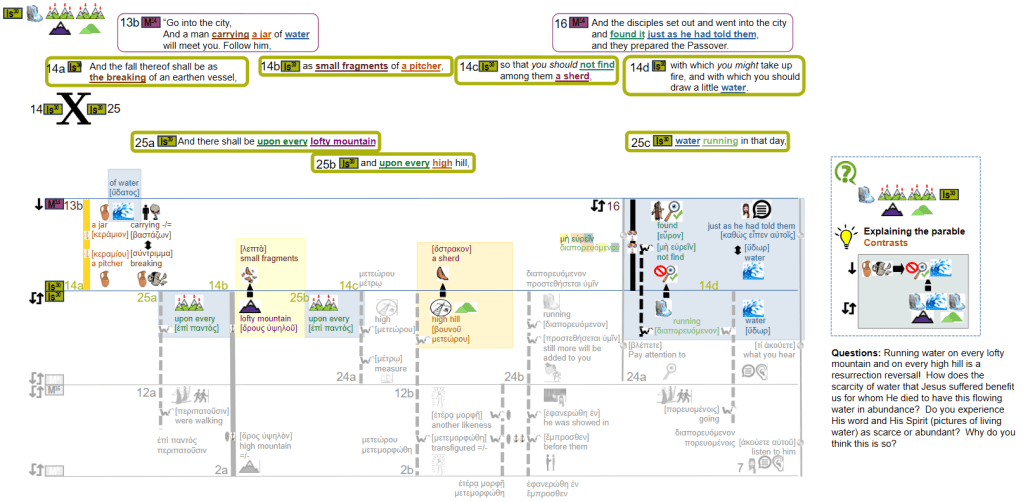
As I mentioned, Mark is building off a contrast in Isaiah 30 that’s already there. He didn’t impose or force it onto Isaiah’s prophecy. What he’s doing is interpreting its fulfillment by the events of Jesus’ suffering and glory. I love the apostle John’s powerful remark: “The testimony of Jesus is the spirit of prophecy” (Rev 19:10). In other words, just like the lifeless body of Adam came to life when God’s breath entered into it, prophecy experiences resurrection life when the testimony of Jesus is breathed into it. This is what Mark is doing here. This Isaiah 30 prophecy had not caught my eye before this. Sure, it is the word of God, but it held no practical relevance to my life or my prayers for churches today. Now, however, I am excited about it and in faith to encounter God in it! Now I see Jesus there so clearly and its implications, not only to me but for His people everywhere.
The man carrying a jar of water is a live action parable depicting Jesus and His inestimably precious sacrifice (see my previous blog “The Man Carrying the Jar of Water Explained!”). Jesus’ death is depicted in terms of a pitcher falling and breaking into small fragments, shards so small that not even a drop of water could be collected in one. Conversely, the small fragments are contrasted with lofty mountains and the shards with high hills, each one with running water. Running water on every lofty mountain and on every high hill is a resurrection reversal! Jesus suffered to the point of scarcity of water (i.e., God) that He cried out, “My God, My God, why have You forsaken Me?” That’s spiritual dryness. In fact, it doesn’t get any drier that this. That’s how much Jesus loves you.
How does the scarcity of water that Jesus suffered benefit us for whom He died to have this flowing water in abundance? In the immediate context of the diagram above, the running water is linked to Jesus’ words—“just as he told them.” You’ll notice the wordplay between “not find” (Isa 30:14) and “running” (Isa 30:25). (Yes, the authors of the Septuagint also crafted wordplays in the Greek translation of the Hebrew text. I was totally surprised when I stumbled across this. Lord willing, I have much more to say on this in a future blog.) The wordplay here draws our attention a huge contrast: not finding water with running water everywhere. Waters flowing down from every lofty mountain and every high hills impacts everywhere below. That’s how life-giving Jesus’ words, particularly as we pay attention to them in the Bible, are to be experienced.
Back to my original question. Do you experience “running water”—Jesus’ words (and His Spirit)—as scarce or abundant? Why do you think this is so? Could it be we haven’t entered into the glorious truth of Isaiah 30? The shattering of the pitcher with no water made ample room for the lofty mountains and high hills flowing with water, just like the first one on Eden’s mountain. I like that Isaiah 30:25 doesn’t even use the word “find.” The waters are right there in the open for the receiving. “To the thirsty I will give water without cost from the spring of the water of life” (Rev 21:6 NIV). “Let the one who is thirsty come; and let the one who wishes take the free gift of the water of life” (Rev 22:17 NIV). The water of life is freely available, not hidden!
A brief word about praying for revival. Being a lover of church history, the revivals of the past have captivated my imagination and ignited my faith in the God who does amazing signs and salvations. I love revival praying. One thing I have a concern with, though, is a lot of revival prayers can unwittingly leave one with the wrong impression of God. Like He’s reluctant to do it except by much pleading and prayers to rouse Him into action. Isaiah 30’s vision paints God more in terms of “thank You” than “please.” It’s more about acknowledging this glory of Jesus in light of His completed work on the cross. The Pitcher has fallen and been shattered. Jesus has been raised and now seated at the Father’s right hand, pouring out the Spirit again and again and again, in river-like fashion, continuously flowing. He is the Baptizer in the Holy Spirit, after all. Believe this with all your heart. I still ask but undergirded by a spirit of thanksgiving towards an abundant, generous Jesus. He’s not stingy or miserly with His Spirit. I don’t need to perform for Him or me “feel right” to receive the Spirit either. Jesus performed it all already. It’s a gift, undeserved, but freely given. I just posture my heart to believe and receive.
Though I have a number of passages I cling to about receiving the Holy Spirit, this one has expanded my faith to see God work in churches like this. Although the Spirit does dwell in each individual believer, the context of Isaiah’s prophecy seems to be hinting at much more. Mountains and hills point to communities of God’s people, made up of individuals having the Spirit. So I love to pray now that God fulfill this vision and make this church or that church full of running water for this service, worship night, or women’s retreat. Jesus deserves it. He was shattered to smithereens and purchased this abundant gifting of living waters (for in the Hebrew parlance running or flowing water is living water). May those waters flow into the streets, schools, and skyscrapers of their local communities. “And there shall be upon every lofty mountain and upon every high hill, running water in that day.” Today is the day!
 Glory Unveiled: Discovering Jesus