Reading the Bible is a big part of cultivating our relationship with God. But how we read is of utmost importance. Is the Bible boring to you? It probably has a lot to do with how you’re reading. Even more critical is reading wrongly. Conceptualizing God wrongly has disastrous consequences for how we live our Christian lives. “What comes into our minds when we think about God,” A. W. Tozer quipped, “is the most important thing about us.” The Gospel of Mark has something startling to say about the formation of our God-perception from the Scriptures. Jesus’ leisurely stroll through grainfields with His disciples one Sabbath day does heavy theological lifting about how we are—and are not—to read the Scriptures.
One Sabbath he was going through the grainfields, and as they made their way, his disciples began to pluck heads of grain. And the Pharisees were saying to him, “Look, why are they doing what is not lawful on the Sabbath?” And he said to them, “Have you never read what David did, when he was in need and was hungry, he and those who were with him: how he entered the house of God, in the time of Abiathar the high priest, and ate the bread of the Presence, which it is not lawful for any but the priests to eat, and also gave it to those who were with him?”
Mark 2:23-26 ESV
“Have you never read what David did?” At first glance, this question sounds strange, considering the audience. These were the Pharisees after all, the Hebrew Scriptures professionals, who’d memorized it backwards and forwards. Of course they’d read it. Mark wants us to think differently about reading God’s word. There’s reading and then there’s reading.
Please permit me to geek in the Greek. The reward is well worth the mental gymnastics! The “never” in “Have you never read” is oudepote (oo-dep’-ot-eh), literally “not ever,” used only 16 times in the New Testament and twice in the Septuagint. Often when Mark uses a rare word only twice, like oudepote here, it’s to forge a literary link between two scenes. If you’re like me, you’ve “never” noticed anything out of the ordinary here. Never is a dime-a-dozen word to us.
Earlier Jesus was at His home in Capernaum, crammed by crowds. Four men carrying a paralytic couldn’t get inside because of the throng, so up to the roof they went, digging through the tiles and lowering him down right in front of Jesus. That’s determination! Jesus, seeing their faith, pronounced God’s forgiveness, creating a firestorm of controversy. To settle the debate, Jesus boldly asserted:
“But that you may know that the Son of Man has authority on earth to forgive sins”—he said to the paralytic— And he rose and immediately picked up his bed and went out before them all, so that they were all amazed and glorified God, saying, “We never saw anything like this!”
Mark 2:10-11 ESV
The “never” in “We never saw anything like this!” is oudepote. Again, this is the only other place Mark employs it. He purposefully links this scene to the grainfields scene, as we’ll see by other reinforcing connections.
Matthew and Luke also report on both scenes. Comparing their word selections to Mark’s highlights Mark’s intentional word choices to associate them. Seeing a lame man walking, the crowd voiced a variety of reactions. Each Gospel author selected their sayings that best aligned with his distinct portraiture of Jesus Christ. So whereas Mark reports the crowd saying, “We never [oudepote] saw [eidōmen] anything like this,” Luke says, “We have seen [eidōmen] incredible things today” (Lk 5:26). Matthew summarizes their response as glorifying the God who had given such authority to men (Mt 9:8).
Furthermore, whereas Mark says oudepote anegnōte (a-neg’-noh-teh)(“never read”), Matthew says ouk anegnōte (“not read”) and Luke says oude touto anegnōte (“not read”). The other Gospels aren’t making an oudepote connection. So, you see, Mark unmistakably wordsmithed oudepote, which persuades me of an intentional literary link for attentive readers to ponder.
Okay, so Matthew’s and Luke’s versions don’t link these scenes together like Mark. So what? Why should I care? Well, through this association, Mark is doing theology for us. It’s his Bible commentary! Mark, under the powerful influence of the Holy Spirit, shows us wonderful aspects about our Lord Jesus. Let’s return to the grainfields for another look at another link.
And the Pharisees were saying to him, “Look, why are they doing what is not lawful on the Sabbath?”
Mark 2:24 ESV
“Look, why are they doing?” is ide ti poiousin (id’-eh tee poi-oo’-sin). Jesus’ answer “Have you never read what David did?” mimics them—anegnōte ti epoiēsen (a-neg’-noh-teh tee e-poi’-ay-sen). That’s a mouthful, but what I want you to see is how ti poiousin (why are they doing) and ti epoiēsen (what did) play off each other. It tees up a clever wordplay of ide (look) and anegnōte (read). Clear as mud? Since I’m a picture guy, I put together this visual to illustrate all this:
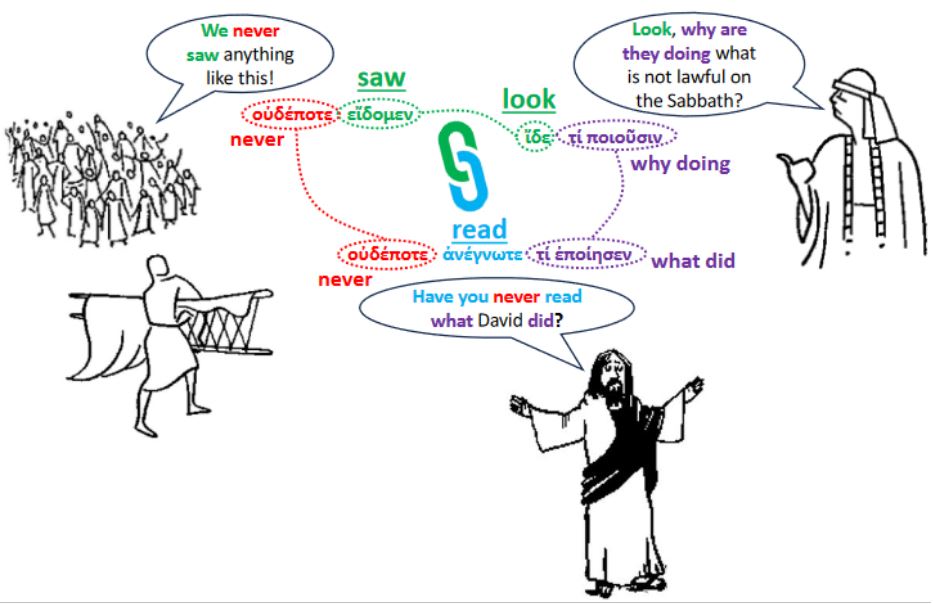
Art credits: drawings adapted from Today’s English Version New Testament (I’ve always loved their cartoons!) and roystoncartoons.com (Jesus cartoons for Easter).
Mark’s finessing here is a ring structure. It’s a three node ring, my telecom background informs me. As per the chain icon above, blue anegnōte (read) pairs with green eidōmen (saw) and ide (look), which sound similar. Ide is an imperative of eidō, a common word for see. Eidōmen doesn’t stem from eidō as you might expect but from horaō (hor-ah’-oh), an intensified seeing like staring. Here’s what this double bond achieves: reading is seeing, reading is looking. So reading is a way of seeing or looking, not with naked eyes but heart eyes, as Paul put it in Ephesians 1.
Mark correlates these two scenes for our imagination to ponder their comparisons and contrasts. It’s intended to shape how we think about reading—seeing—the Bible. The amazed crowd’s “never saw” a paralytic walking is superimposed upon the Pharisees’ “never read.” Implication? Their reading of the Scriptures lacked vision that’s the result of a miracle! The Pharisees saw rules—lawful vs. unlawful. Like the paralytic needed a miracle to walk, they needed one to read! In all their Scripture knowledge, they couldn’t see their Messiah, Jesus. They blindly accused Him as a blasphemer and His disciples as law breakers. The Pharisees are an example. They’re a warning to you and me. Just as the lame man couldn’t walk without Jesus, you’ll never read the Scriptures without Jesus. We too are in desperate need of a miracle to see what the Scriptures aim to reveal. We need Jesus to read God’s way, not man’s way.
That we need for supernatural light for reading the Scriptures might seem a blinding flash of the obvious. After all, Psalm 119 says, “Open my eyes that I might see wondrous things from your law.” Jesus in Luke 24 opened the disciples’ minds to understand the Scriptures. And many more verses. But here’s one of our problems: we mistake information as revelation. The Pharisees, too, had tons of information. Their Bible, though, was a dark room with the light switch turned off. How then do we flip our light switch on to see our Bibles rightly? Mark has much more to say about this. To this we now turn our attention.
These two scenes also have this in common: Jesus presents Himself as the Son of Man, His favorite title for Himself. Now, from Mark’s opening verse all the way to 8:30, Son of Man is mentioned only twice. It’s in these two scenes. From Mark 8:31 onward Jesus’ self-designation as Son of Man picks up dramatically. Matthew and Luke don’t segregate these Son of Man references like Mark does. So what does Jesus as Son of Man have to do with seeing and reading?
The paralytic picking up his mat was a demonstration, a proof.
Which is easier, to say to the paralytic, ‘Your sins are forgiven,’ or to say, ‘Rise, take up your bed and walk’? But that you may know that the Son of Man has authority on earth to forgive sins”—he said to the paralytic—“I say to you, rise, pick up your bed, and go home.”
Mark 2:9-11 ESV
The paralytic walking proved that Jesus had authority to forgive sins. “Who can forgive sins but God alone?” God. This Son of Man is none other than God the Son, the second Person of the Trinity! The paralytic experienced a miracle of walking because this Son of Man exercised His authority. The onlooking crowd enthused, “We never saw anything like this!” Them seeing something never seen before was because of Jesus exercising His authority as Son of Man.
Jesus removed blindness on two levels. The naked eye saw the physical miracle of a paralytic walking. The eyes of the heart saw Jesus as Son of Man who forgave a sinner. “We never saw anything like this!” The lame man walking testified to Jesus’ identity as the Son of Man with authority to forgive sins. Seeing invites coming. Since we’re all sinners, we’re all invited to come to Jesus for forgiveness. Everybody gets this. Everybody knows Jesus forgives. We see John 3:16 everywhere from football games to bumper stickers. Unfortunately, not nearly commonly understood and so well ingrained in our faith, though, is Jesus as Son of Man, Lord of the Sabbath, and what that means practically.
Mark’s two Son of Man references point to Jesus as the high priest. Forgiveness of sins is illustrated by the Levitical priestly sacrificial system, of which the high priest’s role on the Day of Atonement is the apex. Hebrews leaves no doubt that Jesus is our high priest. We’ll now explore Son of Man as yet another fabulous facet of Jesus’ high priestly ministry.
Now, in the grainfields scene, Jesus re-presents Himself as the Son of Man, but with a different twist. The Son of Man is Lord of the Sabbath. Who is Lord of the Sabbath? God, the One who established it from the beginning. Jesus as Lord of the Sabbath is in context of seeing the Scriptures rightly. Mesmerized by morality, the Pharisees saw rule keeping. Their relationship to God was impersonal. God was a cosmic policeman enforcing do’s and don’ts, lawful and unlawful. Mark’s storytelling leading up to the grainfields homes in on personal relationship. The tax collectors and sinners are eating with Jesus (2:15-17). Impersonal calendar-based fasting rituals are set aside by a parable about the Bridegroom. How can the bride fast when she’s with Him (2:18-20)? Afterwards, Jesus summons the twelve “that they might be with him” (3:14). Lord of the Sabbath fits this same inter-relational dynamic. As Mark turns the corner here, he’s combating the prevalent view of handling the Scriptures in a cold, metallic, impersonal way. Rule-oriented living was the old wineskin. The new wineskin of reading the Bible is encountering Jesus, the Bridegroom.
Surprise! Mark has yet one more literary link in this grainfields saga. This holds the key of application for us. This is the difference between “Oh, that’s interesting” and having a life-changing, life-transforming experience with Jesus. My aha moment came after wrestling several weeks with the text, calling on the Lord for understanding.
And he said to them, “Have you never read what David did, when he was in need and was hungry, he and those who were with him: how he entered the house of God, in the time of Abiathar the high priest, and ate the bread of the Presence, which it is not lawful for any but the priests to eat, and also gave it to those who were with him?”
Mark 2:25-26 ESV (emphasis added)
Mark cites the phrase “when he was in need”; Matthew’s and Luke’s versions don’t. What this addition does is establish a link to Jesus’ parable just before:
And the scribes of the Pharisees, when they saw that he was eating with sinners and tax collectors, said to his disciples, “Why does he eat with tax collectors and sinners?” And when Jesus heard it, he said to them, “Those who are well have no need of a physician, but those who are sick.
Mark 2:16-17 ESV (emphasis added)
“Have no need” is ou chreian echousin (oo khri’-ahn ekh’-oo-sin). “He was in need” is chreian eschen (khri’-ahn es’-khen). Chreian, need, is identical in both. Echousin and eschen are forms of echō (ekh’-oh), to have. Now, Matthew, Mark, and Luke all say “have no need” verbatim in the Greek. It’s Mark’s exclusive “he was in need” that unexpectedly weds the parable to the Sabbath grainfields passage. Here’s the aha moment! Need is the golden cord tying this all together. The paralytic needs healing, he also needs forgiveness. The tax collectors and sinners need a forgiving physician. The Pharisees, on the other hand, had no felt need. They felt a superiority as Israel’s official teachers to guide this young rabbi into their wealth of Torah knowledge. “See (you know, because we can see), your disciples are doing what is unlawful on the sabbath.”
Hunger is our body’s way of telling us of our need for food. If you’ve fasted, you really know the feeling! Hunger is what thrusts us to the table again and again and again. The paralytic’s “hunger” for healing and the tax collectors and sinners “hunger” for forgiveness moved them towards Jesus. It was David’s hunger that motivated him to come to the house of God to the high priest for bread. This high priest foreshadowed the one to come. Jesus, Hebrews affirms, is the perpetual High Priest after the order of Melchizedek.
We might adapt the parable this way: Those who can read have no need of the Lord of Sabbath, but those who can’t see. The Pharisees’ problem is ours as well. Just as we cannot be forgiven apart from the Son of Man, we cannot read rightly the Bible apart from the Son of Man. Do yourself a huge favor. Own up that you can’t see. It’s freedom! That sense of need fuels your faith for Jesus to open up your eyes every time you open up your Bible. Yes, we have seen, but—O!—there’s so much more we have yet to see! And what we’ve yet to see is what we’re blind to.
“One Sabbath he was going through the grainfields, and as they made their way, his disciples began to pluck heads of grain.” The “made their way” phrase that only Mark uses confuzzled me. Not just me but other commentators as well. It’s a bit of a mystery. Its word pattern matched nothing in the New Testament. The Septuagint’s similar construction in Judges 17:8 didn’t help. So apparently its significance must derive from within this context alone.
“Made their way” is hodon poiein (ho-don’-poy-ahyn’). Hodon literally is a road or path. How the disciples made their way through the grainfields is anyone’s guess. Did they hack a path through the stalks of grain machete-style? I dunno. It’s too vague to visualize. What is important is its relationship to what follows. Poiein is poieō, the same verb we’ve looked at that is the crux of the Pharisees’ accusation (poiousin) and Jesus’ rebuttal (epoiēsen). The DNLT conveys the Greek syntax better than the ESV: “His disciples began to make their way while plucking the heads [of grain].” “Began” goes with “make” not “pluck.” Since Mark’s ground zero here is the Sabbath, “began” and “make” may echo the very first Sabbath. The Brenton Septuagint Translation of Genesis 2:3 reads, “And God blessed the seventh day and he hallowed it, because in it he rested from all his works which God began to do.” Mark’s “began to make their way” (ērxanto hodon poiein) bears a striking resemblance to Genesis’ “God began to do” (ērxato ho theos poiēsai).
Sabbath is in the limelight. It’s mentioned five times, a lot of repetition for one scene. Sabbath’s core idea is to cease, to stop. It’s often set in contrast with work: work six days, rest one day. So the Pharisees accused the disciples’ plucking the heads of grain as working on the Sabbath. Jesus also wants them to cease from their labors but from a whole different vantage point. God’s ways are higher than man’s ways. Now here’s where things get really interesting.
“One Sabbath he was going through the grainfields, and as they made their way, his disciples began to pluck heads of grain.” Mark omits eating the grain. He only reports plucking the heads of grain. Were they eating grain? Yes, Matthew and Luke clearly state this. But this is not Mark’s point. Keep in mind that the gospel authors don’t present video camera footage of the event. Sure, when you put them all together, then they resemble a movie. But each author’s frugality of words convey a rich theological perspective. They select only those details necessary to frame a theological picture they want to exhibit about Jesus.
There’s a contrast between the disciples picking—but not eating—grain and David and his men eating bread. The disciples’ hunger fades as David’s and his men’s hunger sharpens in our focus. In Mark’s construction of the scene, the disciples’ hunger dilemma tacitly finds its resolution in the house of God. Eating bread, for David and his men, came by the high priest’s giving. This bread was freely given, a gift. David came to the high priest, and they rested from hunger by eating bread that others, the priests, had worked to make.
Jesus, the final high priest, is also Lord of the Sabbath. “Come to me,” Jesus summoned, “all who labor and are heavy laden, and I will give you rest” (Mt 11:28). We apply this wonderful invite in a variety of ways. We may, however, overlook Matthew’s application in context. It’s like Mark’s but from a different angle. The labor is to know the Father and the Son (Mt 11:27). Jesus’ yoke, an idiom then for a rabbi-student bond, was easy and its burden light. Matthew then strolls into the grainfields Sabbath account where the disciples walked right into the heavy ladenness of the Pharisees, who loved to “tie up heavy burdens, hard to bear, and lay them on people’s shoulders” (Mt 23:4). “Look, why are they doing what is not lawful on the Sabbath?” So Matthew and Mark, each in their own way, associate the grainfields with reading and revelation from the Scriptures.
We saw through Mark’s literary craftsmanship how Scripture reading is equated with seeing. Here’s his second point: reading is eating. Reading is like hungering for spiritual food, its satisfaction intermingled with the Sabbath. So as disciples of Jesus we hunger, too. We walk through the grainfields of the Bible seeking to be fed spiritually. Collecting heads of grain is like reading specific passages of Scripture. We are workmen unashamed, gathering those heads of grain, rightly dividing the word of truth. But our “six days” of laboring in the Scriptures must make its way to Jesus. Need fuels our faith to come to Lord of the Sabbath who satisfies our aching craving to know God. The rhythms of working and resting, doing and receiving, find resolution in Jesus. He freely gives us bread we didn’t bake from His presence. “I am the bread of life. The one coming to Me will never hunger” (Jn 6:35 DNLT). “I will give you rest.” Our Shepherd who leads us through the grainfields also delights us with fresh tastes of Himself.
Heads of grain, baked bread. This contrast hints at a miracle. We have a big fat Bible like a Costco warehouse, aisles stacked floor to ceiling with spiritual food. Yet at times, in our reading and studying, our hands are filled with grain but our stomachs are empty. We’re unsatisfied. Bored. We’re bored with God! Boredom is unsatisfied hunger, hunger unfulfilled. Boredom is our soul’s way of alerting us of its need for soul food. Is the Bible boring to you? That’s a sure sign that all you’ve collected is heads of grain but not yet experienced a miracle. The first miracle answers, “Have you never read—seen?” The second miracle answers, “Have you never read—eaten?” The latter miracle is Jesus transforming our gathered heads of grain into fully baked loaves of bread, fresh from His presence! This is not just any bread; this is the bread of the Presence. We need our High Priest’s miracle loaves to satiate our spiritual hunger, our boredom.
We live in the Information Age. The Internet’s instant accessibility to knowledge has many amazing benefits! We can search billions of pages on the world wide web. We’ve got Bible apps, online sermons and podcasts, books, Greek and Hebrew word studies, concordances, atlases, and more all at the click of a mouse. But there is a downside, too. All this biblical data can be an information blizzard blinding us our need to come to Jesus for the satisfying rest of truly knowing God. “Have you never read?” Yes, even in our Information Age, we still need God to reveal God. Biblical knowledge about God does not displace the Waymaker and Miracle Worker to give us light in our darkness. The Pharisees had their pantries full of grain but no bread. They didn’t feel any need for Jesus.
So anticipate miracles when you come to God’s word. Faith consciously depends upon Jesus. The paralytic and his four friends had a faith that would not take no for an answer. No obstacle—crowd, roof, shame—could prevent him from getting close to Jesus. The paralytic had natural helps in his day. Though he lacked our modern day convenience of a wheelchair, he had arms to drag himself along or friends to carry him. Natural helps led by faith directed him to Jesus who transformed him! It’s the encounter with Jesus that transformed him, but it was the natural helps that got him there. Mark’s linking of these two Son of Man stories superimposes their faith upon Jesus as Lord of the Sabbath. Their example is to spur our faith to trust Jesus like that in this Sabbath grainfields context. So don’t ditch all the natural helps—Bible apps, sermons, word studies, etc. Let your faith consciously direct all these helps in the direction of Jesus whose miracles transform you as you study the Bible.
Jesus turned ordinary water into the best wine. The servants could get the water but couldn’t transform it into wine. Jesus multiplied loaves and fishes. The disciples could pass out the food but couldn’t multiply it. Information gathering is what we can do. We can gather lots of heads of grain but we can’t transform it into the bread of the Presence. Jesus is our High Priest who transfigures the heads of grain we gather into fully baked bread! He offers Himself freely as the Bread of life for us to enjoy.
Am I reading a miracle into this? I don’t think so. Mark has his eye on David’s encounter with the high priest. Mark weaves that continuing story into his continuing Gospel narrative. “So the priest gave him the holy bread, for there was no bread there but the bread of the Presence, which is removed from before the Lord, to be replaced [paratithēmi] by hot bread on the day it is taken away” (1Sa 21:6). That paratithēmi (par-at-ith’-ay-mee) shows up 4 times in Mark’s feeding of the 5,000 and feeding of the 4,000. Luke’s feeding of the 5,000 version mentions paratithēmi once; Matthew’s and John’s not at all. “And taking the five loaves and the two fish, he looked up to heaven and said a blessing and broke the loaves and gave them to the disciples to set before [paratithēmi] the people” (Mk 6:41). “And he took the seven loaves, and having given thanks, he broke them and gave them to his disciples to set before [paratithēmi] the people; and they set them before [paratithēmi] the crowd” (Mk 8:6). David initially asked the high priest, “Now then, what do you have on hand? Give me five loaves of bread, or whatever is here” (1Sa 21:3). How many loaves? Five? Hmm.
So from this I conclude that Mark is seeing that bread in the hands of Jesus, the true high priest, brims over with the miraculous. I believe this is Mark’s water into wine miracle. As water is but one ingredient of wine, so grain is but one ingredient of bread. Both wine and bread require additional ingredients as well as laborious process to bring them to completion. Get close to Jesus and ask Him to turn your heads of grain into bread. He delights to do it! Trust Him as your Lord of the Sabbath each and every time you come to the Bible and experience His double miracle of opening the eyes of your heart and satisfying you with fresh bread. Still struggling with getting fresh bread from God’s word? Maybe four friends can carry you into the presence of Jesus. Their faith can overcompensate where you lack.
Nobody says, “I’m hungry. Oh well. I guess God doesn’t want me to eat.” No! We come fully expecting to be fed. That’s what Jesus is inviting us to. Just as confidently we come to Him expecting Him to forgive our sins, we can come to satisfy our hunger, our boredom. Jesus wants us to view Himself as Son of Man, ready to do miracles for us. Do you have any doubt that Jesus will forgive any sin? Then fully trust this same Jesus to be your Lord of the Sabbath to turn any boredom to blessing. Trust him to turn your labors in the Bible into the fresh bread of satisfaction. If we were saved by His death, how much more shall we be saved by His life (Romans 5:10)! Jesus forgives our sins because He died. Jesus rose from the grave to heaven as High Priest because He lives. How much more should we expect Jesus to feed us from His word!
 Glory Unveiled: Discovering Jesus