Much more can be said about Goliath’s sword, of which David remarked, “There’s none like it.” Last time we explored Mark’s hyperlinking the Lord’s body wrapped in a linen shroud to Goliath’s sword wrapped in a cloth. That was breathtaking enough. That was all from just one Old Testament hyperlink. Mark didn’t fabricate this out of thin air. He drew water from the deep well of the Hebrew Bible’s multi-faceted development of Goliath’s sword, crafted to quench Israel’s thirst by a coming Messiah. He glorifies Jesus as Goliath’s sword even more by integrating it with Psalm 93, our adventure for today. What a marvel of literary engineering! I’m floored by how Mark employed verse-by-verse hyperlinking to Psalm 93, leading off the royal psalms, so called because they exalt the Lord as King. And what a royal psalm the 93rd is in the hands of a literary virtuoso like Mark! Christ subsumes even more majesty once you see Goliath’s sword woven into its tapestry.
Mark clusters hyperlinks from cross to tomb that transfigures plain facts into Jesus’ triumphal glories! The Spirit brushstrokes these intellectual facts about Jesus’ person and work onto the canvas of our hearts and minds, transforming us from glory to glory. It is His great delight.
And when evening had come, since it was the day of Preparation, that is, the day before the Sabbath, Joseph of Arimathea, a respected member of the council, who was also himself looking for the kingdom of God, took courage and went to Pilate and asked for the body of Jesus. Pilate was surprised to hear that he should have already died. And summoning the centurion, he asked him whether he was already dead. And when he learned from the centurion that he was dead, he granted the corpse to Joseph. And Joseph bought a linen shroud, and taking him down, wrapped him in the linen shroud and laid him in a tomb that had been cut out of the rock. And he rolled a stone against the entrance of the tomb. (Mark 15:42-46 ESV)
These solemnities happened on “the day before the Sabbath.” “The day before the Sabbath” is just one word in the Greek: prosabbaton (pros-ab’-bat-on), its singular appearance in the New Testament. It’s a header for this scene where Joseph of Arimathea takes center stage, taking Jesus’ body down from the cross and laying it in a tomb.
Now, the Septuagint (the Greek translation of the Hebrew Bible) added its own heading to Psalm 93. It’s not in the original Hebrew, and therefore, not in our English translations (unless footnoted). The Brenton Septuagint Translation puts it this way:
For the day before the Sabbath, when the land was first inhabited, the praise of a Song by David.
“The day before the Sabbath” here is prosabbaton, its only appearance in the Septuagint. A one-time word in Mark’s Gospel linked to a one-time word in the Septuagint, though infrequent, is a recurring pattern. Since I’ve observed it as a literary technique that Mark uses consistently, I’ve coined it a “golden anchor.” It anchors a scene in Mark to one in the Hebrew Bible so you don’t have to guess if Mark’s peculiar word was meant to sync up with that particular Old Testament scene. It does. So what these one-to-one one-of-a-kind word links do is instill a rock solid confidence of the author’s intention to associate them together. So Mark handpicked prosabbaton, “the day before the Sabbath,” the day of Jesus’ burial, as an exclusive pointer to Psalm 93! It’s not merely a cross reference. It bridges events in the life and death of Jesus Christ to the whole psalm. Psalm 93 is raised as a beautiful banner over Mark’s cross-to-grave account.
All five verses of Psalm 93 are thematically linked with Mark’s Gospel. All this can’t be stuffed into one blog. So to use the blind men and the elephant analogy, I’ll introduce “a thick snake,” the blind men’s perception of the trunk. Lord willing, next time I’ll show you “a tree trunk” (the elephant’s leg), then “a fan” (its ears). It’s still advantageous to show you the disjointed pieces, knowing full well the elephant won’t be conceptualized until later. Each piece will increase your amazement at your Lord Jesus, the whole elephant so much the more! So for today we’ll focus on Psalm 93’s first verse’s connections with the suffering and death of Jesus and its relationship to Goliath’s sword.
Notice how verse one has same word for “clothed” two times:
The Lord reigns; he has clothed himself with honour: the Lord has clothed and girded himself with strength…
Psalm 93:1 (Brenton Septuagint Translation)
Both instances of “clothed” is Greek enedysato (en-eh-doo’-sah-tah), a form of endyō (en-doo’-oh), a commonplace verb for putting on clothes. Mark employs endyō three times. Since endyō appears three times in Mark’s Gospel and not just once, how do we know which one is an intentional hyperlink, if it is? Great question. Let’s consider the first two instances and then the third. Mark 1:6 refers to John the Baptist clothed [endedymenos (en-deh-doo’-men-os); endyō] in camel’s hair. There’s no thematic relationship to the Lord clothing Himself with honor. Likewise, the context of Mark 6:9 is dress codes for Jesus’ disciples going out to preach. Mark 15:20, though, refers to the Lord clothing Himself. “And when they had mocked him, they stripped him of the purple cloak and put [enedysan (en-eh’-doo-sahn); endyō] his own clothes on him. And they led him out to crucify him.” It’s a matching theme between the psalm and Mark. What’s even more compelling is its relationship to our golden anchor, prosabbaton, “The day before the Sabbath,” which is Good Friday. When did the Roman soldiers put Jesus’ clothes on? Good Friday, the day before the Sabbath.
Since I think better with pictures, and as all this hyperlinking can be a little challenging to mentally grasp, I put together this diagram you may find helpful to visualize:
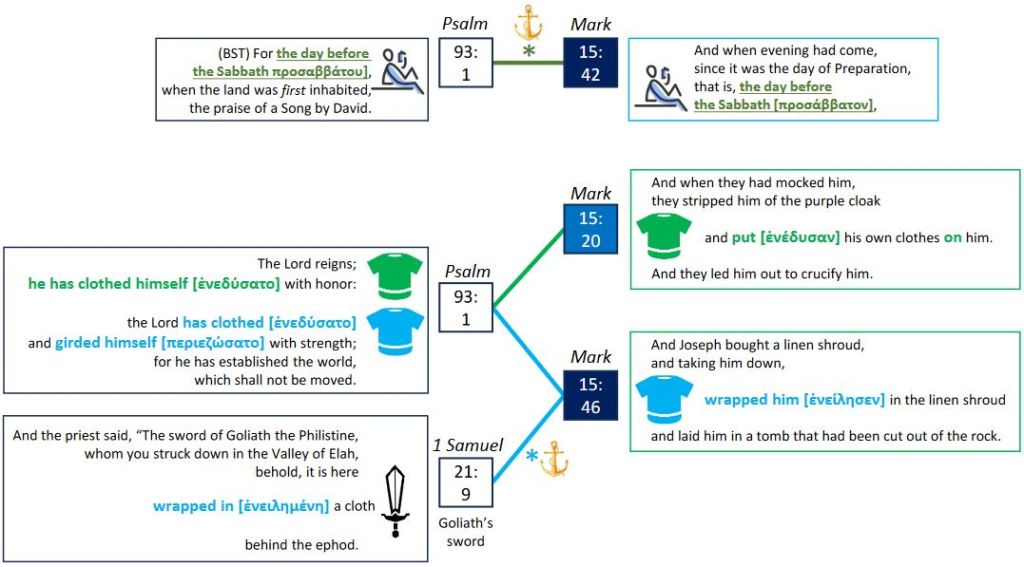
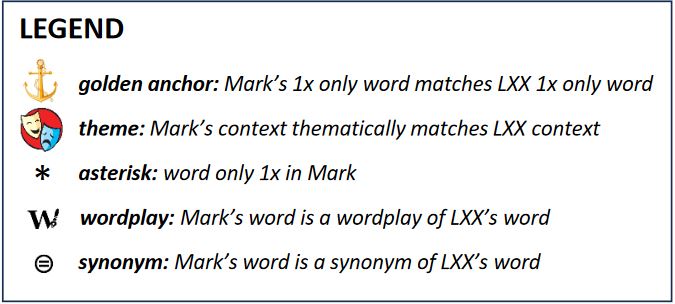
The prosabbaton golden anchor secures Psalm 93 as a lens through which to gaze upon Good Friday. These Roman soldiers heaped shame upon Jesus, mocked by having Him wear a purple robe, a king’s emblem. But look what Psalm 93 does in envisioning this event: “The Lord reigns; he has clothed himself with honor.” Pontius Pilate’s soldiers mocked Jesus’ reign; the psalmist extols Jesus’ reign. They “put [endyō] his own clothes on him” as they marched Him off to Calvary. “He has clothed himself [endyō] with honor. The clothes our Savior wore to His cross were the clothes of honor! Jesus is modeling God’s kingdom for us, and it looks totally different than the world’s definition. The Lord reigns through submission. “He humbled himself by becoming obedient to the point of death, even death on a cross” (Phil 2:8).
Psalm 93:1 speaks of “clothed” twice, which Mark mimics twice. Watch with wonder how he integrates the second endyō. “…The Lord has clothed [endyō] and girded himself with strength.” Psalm 93:1’s thematic element of “clothed” pops up again in Mark 15:46: “And Joseph bought a linen shroud, and taking him down, wrapped him in the linen shroud…” For “wrapped…in” Mark uses eneileō (en-i-leh’-o). Now, eneileō is obviously not the same as endyō but it is a synonym in its spitting image.
As I’ve gotten to know Mark, his hyperlinks to the Septuagint comprise three variations on his Greek word choice: the same word, a synonym, or a wordplay. This he does over and over again. It’s a predictable pattern. Here we’re dealing with a synonym. Eneileō is perfectly suited as it incorporates both “clothed” and “girded himself.” For “clothed” this rare as hen’s teeth word eneileō preserves the original flavor of “wrapping around” baked into the Hebrew lāḇaš (law-bash’). Lāḇaš also means clothing oneself or another, literally or figuratively. “Girded himself” is the Greek perizonnumi (per-id-zone’-noo-mee) from peri, around, and zōnnymi (dzone’-noo-mi), to gird or encircle oneself with clothing, usually a belt or sash. So eneileō is a combination of both words “clothed” and “girded himself.”
Eneileō, like prosabbaton, is a golden anchor, a one-to-one mapping between the New Testament and the Septuagint in 1 Samuel 21:9. Take another look at the diagram above. Go ahead; I’ll wait for you. It entwines Jesus’ body wrapped in a linen shroud with Goliath’s sword wrapped in a cloth. That’s the beauty of eneileō’s golden anchor. Woven into the tapestry of Psalm 93, eneileō as synonym of endyō and perizonnumi forms a thematic link to “The Lord has clothed and girded himself with strength.” Mark is blanketing Joseph’s wrapping the body of Jesus with another profound layer of meaning. By Goliath’s sword, Jesus slew Goliath, the devil, the one who used death as a weapon to slay Him. That’s strength! What appears to be weakness and defeat, Psalm 93 heralds as strength and the Lord reigning! We’re to see this simple act of wrapping the body of Jesus in a linen shroud as the strength of Yahweh’s reign. That’s how He clothed and girded Himself with strength. I recommend when you read Psalm 93 to meditate on this parallel imagery in Mark and see what it does for your heart in adoration and love for the Lord Jesus.
As a side note, the icon of a wrapped baby in the drawing above was intentional. Not only does it convey wrapped better than a burrito icon can, but Jesus’ birth was where Mary wrapped Him tightly in swaddling cloths. That was a preview of this Good Friday event.
There’s one more Easter egg in Mark’s cross to tomb scene that exalts Goliath’s sword as the Lord reigning. “And when [Pontius Pilate] learned from the centurion that he was dead, he granted [ἐδωρήσατο] the corpse to Joseph” (Mark 15:45). This dōreomai (do-reh’-om-ahee) only appears this one time in Mark’s Gospel. There are three instances of it in the Septuagint and the one that matches thematically is unmistakable. “On that day King Ahasuerus gave [ἐδωρήσατο] to Queen Esther the house of Haman, the enemy of the Jews. And Mordecai came before the king, for Esther had told what he was to her” (Est 8:1). The exact same form of dōreomai is shared by both sides of the hyperlink, illustrated as follows:
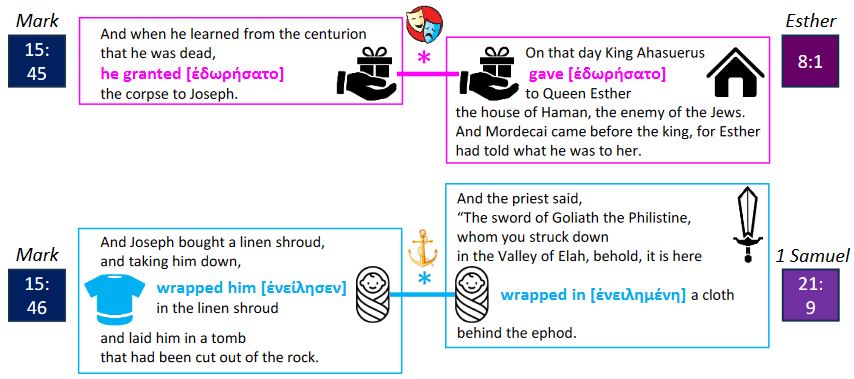
The characters performing the giving in both scenes are the highest authorities in the land. King Ahasuerus was the supreme leader of the Persian Empire. Pontius Pilate, representing Caesar, was the supreme leader of the Roman Empire over the land of Palestine. In Pilate giving the body of Jesus to Joseph, the dōreomai hyperlink superimposes the imagery of all that belonged to Haman, the enemy of the Jews, officially transferred to Queen Esther. Our takeaway? All that belonged to the enemy of the Jews, Satan—all his house—was transferred to King Jesus! The very next verse heralds Jesus as Goliath’s sword, slaying the uber-Goliath, using Satan’s own weapon of death to defeat him, even as Haman’s weapon of death, the gallows, defeated him.
Mark’s telling of Satan tempting Jesus in the wilderness was very brief. Matthew’s and Luke’s verbose accounts record Satan offering the whole world, which of course, Jesus refused. For Mark, this giving of the world from Satan to Jesus is framed in its glorious reality. Jesus’ death marked this awesome transfer of all of Satan’s house over to Him! Through the death of Jesus, the house of the Enemy of the Jews officially transferred ownership to King Jesus. The world is under new management. “I died, and behold I am alive forevermore, and I have the keys of Death and Hades” (Rev 1:18). He won them at the Cross and will never relinquish those keys. Ever. I love David statement about Goliath’s sword, “There’s nothing like it.” That’s our Lord Jesus! There’s nothing or no one like Him!
I’d like to pause before we close to appreciate the body of Christ. We have Bible study tools that are the product of hundreds of men and tens of thousands of hours to achieve what couldn’t be done even a hundred years ago. The Blue Letter Bible app is my go-to. Tools like this give much success on seeing Jesus in the Bible. I couldn’t have researched all these hyperlinks so effectively without it. The written word, though, is both human and divine like the living Word, Jesus, is. There’s no other book like the Bible. Its divine side demands our wholehearted trust upon the Holy Spirit, the Breath that animated these literary virtuosos like Mark. We need an active, present tense reliance on the Holy Spirit to open our eyes and lead us. I pray every day before opening God’s word to be filled with the Spirit. It’s not just a doctrine. I need Him or I’ll miss Jesus. So Mark’s hidden gems are the mercy and grace of the Spirit of truth working through His body. To God be the glory!
Before the Spirit taught me to read Psalm 93 through Mark’s eyes, I’d always envisioned the Lord clothed with glory and majesty as the lofty throne room scene of Isaiah 6. The train of the Lord’s robe is filling the temple, innumerable hosts of heaven are crying out “Holy, holy, holy!” While this is true, Mark shows us the Lord clothing Himself with honor and strength in a radically new way, upending our well worn ruts of thought. He directs our imaginations to the Lord clothing Himself with glory and majesty during His passion. The putting on of His own clothes as He was led out to be crucified was clothing Himself with honor! The wrapping of the linen around His body was clothing and girding Himself with strength! All praise to the Lord Most High!
 Glory Unveiled: Discovering Jesus