The world’s finest athletes are gathering for the Olympics this summer in Paris to compete for the gold in a wide array of contests. In considering how Mark integrated Psalm 93 to ascribe significance to the events of Good Friday, I find an analogy to these optimum achievements in the athletic world. But I had to include the Winter Olympics to do so. Mark’s word finesse with the Greek and Hebrew are like nimble, balletic couples ice skating, combining amazing athleticism within a choreographed dance of jumps, twists, twizzles, flips, spins, lutzes, and three and a half turn triple axels. I hope over these next blogs to show you Mark’s gold medal literary performance par excellence.
Last time we briefly introduced the lively world of Psalm 93, a royal psalm celebrating the Lord’s reign. We examined Mark’s one time usage of prosabbaton, the day before the Sabbath, and its one time usage in the Septuagint, the heading of Psalm 93, as a “golden anchor.” This golden anchor bridges Psalm 93 to Good Friday, the day before the Sabbath. It reimagines Mark’s recounting of the events of Good Friday in light of the psalm’s triumphal assertions. Mark has his eye on this psalm. So let’s briefly review the links between Psalm 93:1 and Mark 15 from last time.
The Lord reigns; he has clothed himself [enedysato] with honour: the Lord has clothed [enedysato] and girded himself with strength…
Psalm 93:1 Brenton Septuagint Translation
Both instances of “clothed” is Greek enedysato (en-eh-doo’-sah-tah), a form of endyō (en-doo’-oh) for putting on clothes. Since Mark employs endyō three times, it’s not a golden anchor but is thematically linked. “And when they had mocked him, they stripped him of the purple cloak and put [enedysan (en-eh’-doo-sahn); endyō] his own clothes on him. And they led him out to crucify him” (Mk 15:20). The clothing themes match between the psalm and Mark, in a quite unexpected way. Jesus, battered, bruised, and bloodied, being led off to crucifixion in His own clothes is probably not what we had in mind for, “He has clothed himself with honor.” But Mark boasts unashamedly that the clothes our Savior wore to His cross were the clothes of honor! Pontius Pilate’s soldiers clothed Jesus in a purple robe of shame; the psalmist extols Jesus’ humiliation as being clothed with honor.
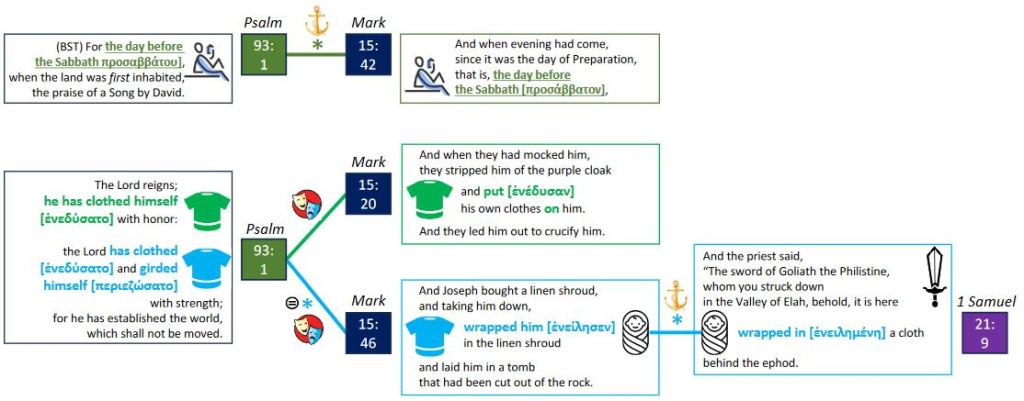
Psalm 93:1’s second endyō, “The Lord has clothed and girded himself with strength,” is echoed by Mark 15:46: “And Joseph bought a linen shroud, and taking him down, wrapped him in [eneileō (en-i-leh’-o)] the linen shroud…” Eneileō is a perfectly suited synonym of endyō, incorporating both “clothed” and “girded himself.” Eneileō is also a golden anchor, uniting Goliath’s sword wrapped in a cloth (1 Samuel 21:9) with Jesus’ body wrapped in a linen shroud. These clothing themes match between the psalm and Mark, again in a startling way. Jesus’ dead body wrapped in a linen sheet probably didn’t occur to us when reading, “The Lord has clothed and girded himself with strength.” What seems weakness and defeat, Psalm 93 heralds as strength and the Lord reigning! This wrapping the body of Jesus in linen is the strength of Yahweh’s reign, for Jesus as Goliath’s sword slew the Goliath of this world system, the devil, wielding his own weapon of death against him.
So today we’ll pick up where we left off by examining more links in Psalm 93’s first verse. Focusing on verse one (excluding the header), here are more literary links:
What persuades me that Mark hyperlinks even more to Psalm 93 is “silver anchors.” Unlike a golden anchor, a one-of-a-kind word in Mark’s Gospel linked to a one-of-a-kind word in the Septuagint, a silver anchor’s one-of-a-kind word in Mark has multiple instances in the Septuagint. Nevertheless, silver anchors indicate the author’s intentional hyperlinking as golden anchors do. Mark’s silver anchors occur in four of five verses of Psalm 93, the fifth verse having some cool thematic linkings.
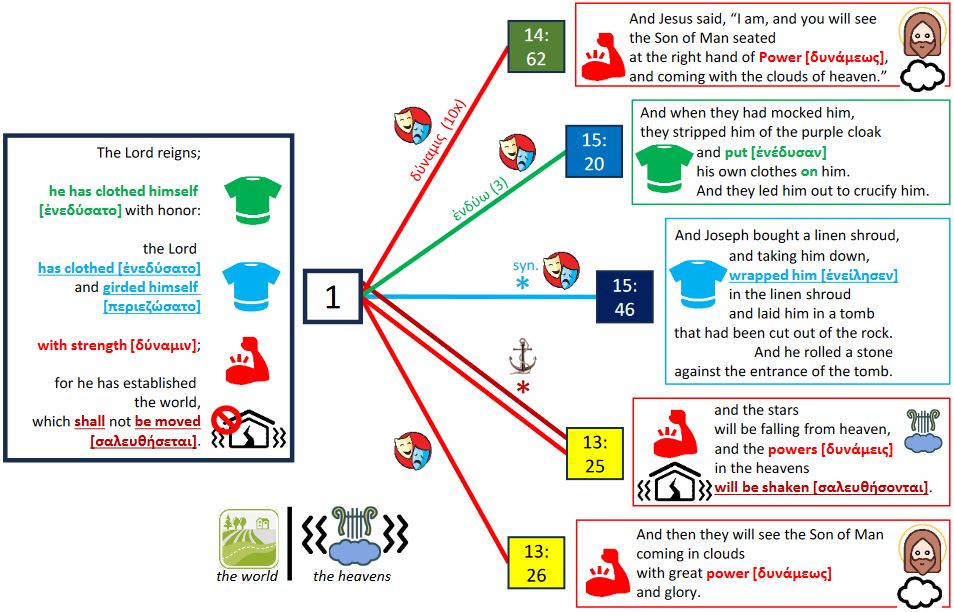
You’ll notice in the drawing above that saleuthēsontai (sal-yoo-thay’-son-tahy), “will be shaken,” in Mark 13:25 is a silver anchor. Saleuthēsontai is saleuō (sal-yoo’-oh), an agitation or shaking produced by winds, storms, or waves. Now what’s interesting is that Mark’s one time use of saleuō breaks the pattern of events tied to Good Friday and peeks far into the future when Christ comes again. As Jesus sat with His disciples on the Mount of Olives opposite the temple, He set the stage for those signaling events prior to His Second Coming. “But in those days, after that tribulation, the sun will be darkened, and the moon will not give its light, and the stars will be falling from heaven, and the powers in the heavens will be shaken [saleuō]” (13:24-25).
Mark contrasts the world that will not be moved with the powers of the heavens that will be moved. Both saleuō verbs are constructed as future passive indicative but singular (world) in Psalm 93 versus plural (powers) in Mark 13. Their inverse relationship makes profound theological statements about what the death of Jesus did!
The saleuō silver anchor has a companion hyperlink, dynameis (doo-nam’-ice). It’s a perhaps familiar word to you, dynamis (doo’-nam-is), power or strength, from which we get our words dynamite, dynamic, and dynamo. Although Mark uses dynamis ten times, its interconnectedness with the saleuō silver anchor indicates its intentional link to Psalm 93:1. The Lord clothing and girding Himself with strength—power—conversely unclothes the heavens of their powers, the stars falling from heaven. And it’s this shaking of the powers in the heavens that makes the world unshakable.
What is meant by “world” here? Though it can indicate the terrestrial globe, the Hebrew têbêl (tay-bale’) emphasizes the inhabitants that dwell upon the earth. It’s the people upon it. The Septuagint agrees with that view, using oikeō (oy-keh’-oh) as a participle, those living inside a house. So world is the peoples living upon it that will not be shaken. It’s looking forward to the church, a house of prayer for all nations, built upon an immovable rock, of which Jesus assured, “…the gates of hell shall not prevail against it” (Mt 16:18). So the Lord Jesus clothed Himself with honor as He wore His own clothes to His crucifixion. He clothed and girded Himself with power as Joseph of Arimathea wrapped the linen burial cloth around Him. Jesus’ sacrificial death, as indicated here, is the primary cause resulting in a world, the peoples, which shall not be moved.
Let’s now look at the inverse side of this cause-effect that Mark is drawing our attention to. “But in those days, after that tribulation, the sun will be darkened, and the moon will not give its light” (13:24). In its chapter 13 setting, tribulation refers to the global calamities: nation rising against nation, earthquakes and famines, “such tribulation as has not been from the beginning of the creation that God created until now, and never will be” (13:19). These calamitous events are what precede Jesus’ Second Coming. But Mark’s clever hyperlinking reroutes our mind to envision a tribulation associated with Jesus’ first coming. Jesus suffered great tribulation at the hands of God, men, and devils, such as has not been from the beginning of the creation that God created until now, and never will be. We will develop this more in a future blog. The great tribulation at the end of the age is an outworking of the great tribulation of Jesus.
“But in those days, after that tribulation, the sun will be darkened, and the moon will not give its light, and the stars will be falling from heaven, and the powers in the heavens will be shaken.” Did these events transpire after Jesus’ tribulation? Yes, most certainly! Let’s investigate the trail of breadcrumbs Mark has laid out for us to explore. Sun, moon, and stars are created objects that have been established as symbols in the Hebrew Bible. As symbols they make sense in Mark’s reframing of these events. Genesis 1 presents the “greater light,” the sun, and the “lesser light,” the moon, as rulers over the day and the night. The sun, moon, and eleven stars bowing down to Joseph in his dream are symbols easily interpreted. Jacob deciphers, “Shall I and your mother and your brothers indeed come to bow ourselves to the ground before you?”
“After that tribulation, the sun will be darkened.” What does a darkened sun mean, thinking in terms of symbols? Well, from the Genesis passages cited above, it means that it no longer rules. The sun’s authority to rule the day has been stripped away. After Jesus’ tribulation, His death and burial, was there a sun, a supreme ruler, that was darkened, that lost its authority to rule? Yes, the arch-nemesis of humanity, Satan, the devil, the ancient serpent who’d unleashed a Pandora’s box of evil. Ephesians 2 calls him the god of this world, in other words, a sun, the chief ruler of the heavenly realms. Jesus predicted it. “Now is the judgment of this world; now will the ruler of this world be cast out. And I, when I am lifted up from the earth, will draw all people to myself” (Jn 12:31-32). Paul confirmed it. “He disarmed the rulers and authorities and put them to open shame, by triumphing over them in him” (Col 2:15). The previous Colossians verses lets us know that this triumph was because of Jesus’ tribulation: His death on the cross.
When the Lord robed Himself with His own clothes for the cross and a linen burial shroud for the tomb, the sun was disrobed of its glory along with the moon. The sun darkened and moon not giving its light is stripping away their rule. Sun—supreme ruler, Satan—darkened means its light, its authority, is diminished. We’ll discuss what the moon means in this context later on after other pieces of the symmetries have been developed. But for now, the sun as a leading figure is obvious. The stars are also obvious. These are the “rulers and authorities” subservient to the sun, the chief ruler, Satan. The fallen angels in league with Satan have been stripped of their royal robes as well.
The drawing above shows a chiasm, a mirroring pattern. Mark 14:62 and 13:26 are bookends mirroring each other, unified by the common themes of the Son of Man, power, and clouds. The next pairing is Mark 15:20 and 13:25, which we will unpack shortly. At the center of this chiasm is Mark 15:46 where Jesus’ body is wrapped in a linen shroud. The center of a chiasm denotes the central idea and most important emphasis. The very first drawing above illustrated the golden anchor from 15:46 to Goliath’s sword in 1 Samuel 21. In Mark’s crafting of these lovely symmetries, “The Lord has clothed and girded himself with strength” corresponds to Jesus’ dead body wrapped in a linen sheet. The wrapping of Jesus’ body and the wrapping of Goliath’s sword depict the Lord Jesus as Goliath’s sword, the One who through death slew the Goliath, the devil, who’d weaponized death against Him.
Now we can re-envision the David and Goliath scene using the celestial symbols as Mark’s chiasm implies. In this terrestrial setting Goliath is a sun, all the Philistine soldiers are stars. When Goliath was killed by his own sword, the sun was darkened: his terrifying dominion over Israel ceased. This battle royale between David and Goliath was a preview of the greater David and greater Goliath to come. The Son of David cut off the head of the ancient serpent! Jesus as Goliath’s sword put Satan’s lights out! So the ideas are one, but cast in different imaginative lights. The “powers of the heavens” were shaken too. “When the Philistines saw that their champion was dead, they fled” (1Sa 17:51). They all fled before Israel. Jesus’ death and burial signaled a corresponding victory over the stars of heaven, Satan’s demonic soldiers. They were shaken and moved. They fell.
In closing, let’s revisit that pairing of Mark 15:20 and 13:25. The Romans soldiers stripping Jesus of the purple cloak is juxtaposed with the stars falling from heaven, those powers being shaken. The purple cloak was an emblem of a king’s robe. Of course, these Roman soldiers did it as part of their mockery of Jesus as King of the Jews. Here’s what the chiastic pairing up gets us thinking about: the stripping of the purple cloak matches up with the stars falling from heaven and the powers of the heavens being shaken. Jesus stripped the spiritual principalities and powers of their purple cloak! The sun and stars had their rule taken away. King Jesus now wears the purple cloak, not one of mockery but of cosmic reality! “He who sits in the heavens laughs; the Lord holds them in derision. Then he will speak to them in his wrath, and terrify them in his fury, saying, ‘As for me, I have set my King on Zion, my holy hill’” (Ps 2:4-6). It is the Lord who is doing the mocking now.
The antagonists of the skies were shaken by our Protagonist’s death and burial. This first shaking of the heavens will at last be consummated by the final one when Jesus comes on the clouds with great power and glory! Then will the presence of Satan and his angels be totally exterminated, eternally banished to the lake of fire that was prepared for them.
In considering all this, perhaps this question came to mind. If all this is true, why does Satan still hold so much sway? I mean, we look around the world today and see so many devastating effects of Satan’s kingdom. True. We live at a time before Christ’s return where sin and Satan, though defeated, are still present and actively exerting their influences. But what Mark is doing by all these hyperlinks to Psalm 93 is rewiring our thinking to view spiritual realities in light of Jesus’ death and burial. Grasping these spiritual realities will help us as the Church by faith to assume her rightful place in this cosmic struggle.
Just like we still contend with the presence of sin from within, we still contend with the presence of spiritual foes from without. There is coming a day when both the presence of sin and the presence of wicked powers will be vanquished forever. The basis of our expectation of living free from sin is understanding that we are dead to sin and alive to God (Rom 6:11). Likewise, our expectation of fulfilling our original Adam and Eve commission to subdue and rule is understanding that Satan and his angels have been defeated. Their sun has been darkened and their stars have been shaken and fallen from their places of dominion.As we see what’s true and then believe what’s true, we progressively enter into actual possession and experience of what’s true. “…on this rock I will build my church, and the gates of hell shall not prevail against it” (Mt 16:18). Gates are defensive measures to protect a city. In other words, the Church is on the offense, not the defense!

