Mark presents Jesus as God’s servant, a pervasive theme having compelling implications. How shall we serve? What heart attitudes hinder genuine service? What success may we expect against external forces that oppose our kingdom service? Mark anticipates these questions with a variety of responses. A right understanding of Christ’s death, burial, and resurrection radically impacts our effectiveness in serving, particularly in regards to the opposing spiritual forces of darkness. “For we do not wrestle against flesh and blood, but against the rulers,…against the spiritual forces of evil in the heavenly places” (Eph 6:12). How does what Jesus did then impact what His church does now to build His kingdom on earth?
To answer that, Mark crafted stunning literary links to Psalm 93, the first of the royal psalms. These hyperlinks renew our minds to perceive spiritual realities in light of Jesus’ death and burial. Why does this matter? As we see what’s true, we believe what’s true. By faith we then progressively experience what’s true. We’ll assume our rightful place in this cosmic struggle. Instead of living lives defeated by sin and Satan, we’ll progressively enjoy the spoils of Jesus Christ’s victory. We can live free from sin today because we see and believe what’s already true: we are dead to sin and alive to God (Rom 6:11). Similarly, we can fulfill the original commission to subdue and have dominion (Gen 1:28) because we see and believe that King Jesus has already been victorious over Satan and his demons.
Psalm 93 has five verses in most of our English translations, but the Septuagint added a heading that makes six. I’ll retain Psalm 93’s common one-to-five verse numbering, handling verse one as two verses. That extra heading is important, as has been pointed out, because in it Mark linked prosabbaton (pros-ab’-bat-on), the day before the Sabbath, to his reporting of Good Friday, the day before the Sabbath. This one-of-a-kind literary link transforms Psalm 93 into a looking glass to marvel at the royal implications of Good Friday.
Mark’s hyperlinking to Psalm 93 divides the psalm neatly into two panels of three verses each. It’s breathtaking and super cool! In origami fashion the two panels fold over each other, mirroring each other. In literary lingo this is a chiasm. A chiasm is like a sandwich, its two outer edges of bread having matching layers of cheese or meat within. A chiasm is like an X, where the top ‘v’ of X and the upside down ‘v’ of its bottom mirror each other. The point where the two v’s meet is what’s being emphasized. What these mirrored comparisons do is give a depth perception, sort of like how our two eyes give us a 3D depth perception. Mark’s chiastic construction with Psalm 93 deepens insight into Good Friday for our hearts to ponder.
So for today we’ll observe how Psalm 93 verses 1 and 4 pair up, illustrated as follows:
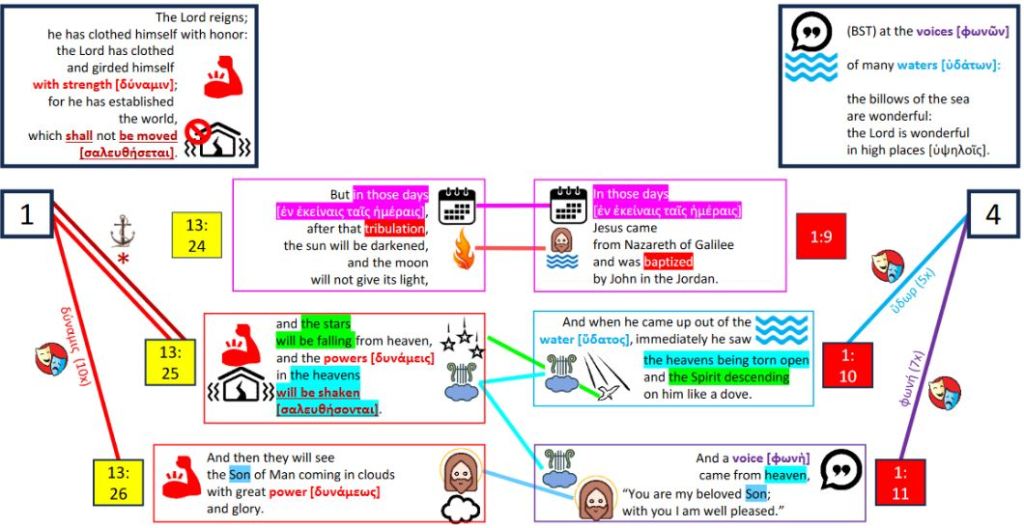
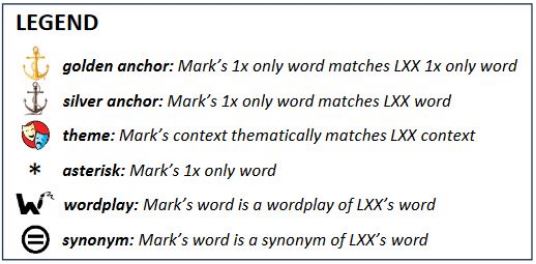
Psalm 93:4 reads in the ESV as “Mightier than the thunders of many waters, mightier than the waves of the sea, the Lord on high is mighty!” An English translation of the Greek Septuagint reads a bit differently: “At the voices of many waters: the billows of the sea are wonderful: the Lord is wonderful in high places” (Brenton Septuagint Translation, or BST). So the Septuagint says “voices” (φωνῶν phōnōn (foh-nohn’)) rather than “thunders” but agrees on “waters” (ὑδάτων hudatōn (hoo-dah’-tohn)). Phōnōn and hudatōn are used in Mark’s gospel 7 times and 5 times, respectively. Phōnōn and hudatōn together only occur in one place in Mark: the baptism of Jesus in the River Jordan. Mark also has hyperlinks with “wonderful” and “high places” that we’ll inspect next time.
The Lord girding Himself with strength and establishing the world so it not be moved (verse 1) is laid alongside the voices of many waters (verse 4). Since the diagram above is a bit of a fire-hose of information to take in all at once, we’ll walk through it piece by piece. The first piece, the first row, is Mark 13:24 and 1:9:

Neither has any hyperlink to Psalm 93. Their relevance stems from their organic connections to their respective succeeding verses that do hyperlink to Psalm 93. Mark’s identically worded “in those days” forms a literary link between them (occurring also in Mark 8:1 and 13:17 but in no other Gospel). What’s interesting is that the context of Mark 13 is the Second Coming of Christ. “After that tribulation” in 13:24 refers back to what Jesus was saying about wars and rumors of wars (verse 7), earthquakes and famines (verse 8), and His followers being hated by all (verse 13), just to cite a few.
Mark alone pairs up the cosmic cataclysms of Christ’s Second Coming with the baptism of His first coming. What this does is match up “tribulation” and “baptized,” juxtaposing these cosmic cataclysms with that River Jordan baptism. To say it another way, Jesus’ baptism is tribulation. This concept is not foreign to Mark, for in 10:38 he quotes Jesus as saying, “Are you able to drink the cup that I drink, or to be baptized with the baptism with which I am baptized?” (10:38) The cup of suffering—Jesus’ great tribulation—is associated here with baptism.
The next verses detail what happens “after that tribulation,” that is, after Jesus’ baptism under Jordan’s waters. Take a look now at the middle row comparisons:
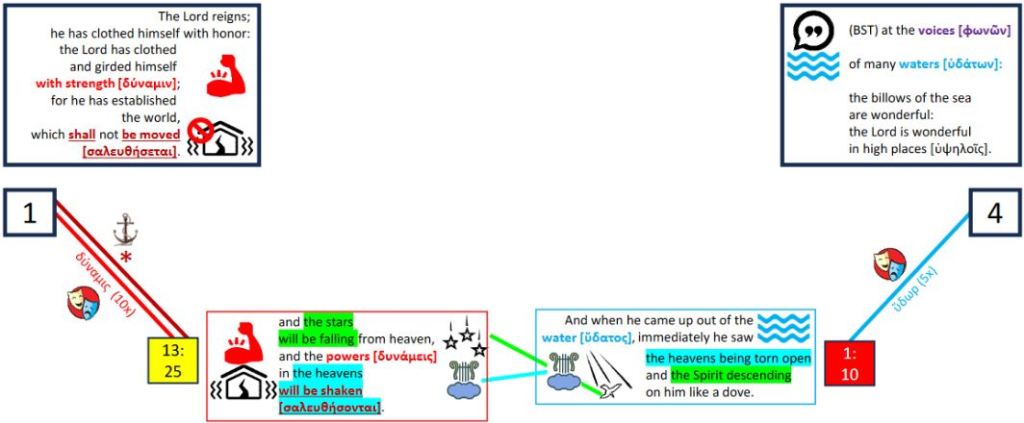
Notice similarities between the two. Both have a disruption in the heavens. On the left, the powers of the heavens are shaken. On the right, the heavens themselves are torn open. The heavens being shaken like an earthquake parallel the heavens being torn open.
Both have a downward movement from the heavens to earth. “The stars will be falling” parallels “the Spirit descending.” “Falling” is piptontes (pip’-ton-tes), the present participle of piptō (pip’-toh). Interestingly, the descent of the Spirit from heaven is occasionally referred to as falling (epipiptō (ep-ee-pip’-toh) “falling upon”; see Acts 8:16, 10:44, 11:15). Last time we looked at the inverse relationship between the earth (i.e., the people dwelling upon it) not being moved (Psalm 93:1) and the powers in the heavens being shaken or moved (Mark 13:25). These side-by-side comparisons highlight profound spiritual realities about what the death of Jesus did!
The heavenly disruptions resulting in falling stars and descending Spirit were themselves caused by the tribulation of Jesus’ Jordan River baptism. That baptism, signifying death and burial, effected a monumental change in the heavenly realms. Mark is doing some heavy duty theology on par with the apostle Paul (e.g., “He disarmed the rulers and authorities and put them to open shame, by triumphing over them in him” (Col 2:15)). In some ways Mark has even more theological depth. This surprised me as I’ve typically thought of the relationship of the Gospels to the epistles as progressive, the Gospels like a bud and the epistles its bloom.
“But in those days, after that tribulation, the sun will be darkened, and the moon will not give its light, and the stars will be falling from heaven, and the powers in the heavens will be shaken” (Mk 13:24-25). To recap from last time, the silver anchor saleuō (sal-yoo’-oh; “moved”/“shaken”) has a companion hyperlink, dynamis (doo-nam’-ice; “strength”/“powers”) bridging Mark 13:25 to Psalm 93:1. A silver anchor, if you recall, is a one-time Greek word occurring in Mark linking to the same word (but amid multiple occurrences) in the Septuagint, its unique linkage established by commonality of theme. The Lord clothing and girding Himself with strength—power—conversely unclothes the heavens of their powers, the stars falling from heaven. This shaking of the powers in the heavens (Mark 13) made way for the world—the peoples living upon it—to be unshakable (Psalm 93). Jesus Christ our Lord clothed Himself with honor, those clothes He wore to the cross, and clothed Himself with strength, that wrap-around linen burial cloth to the tomb, a hyperlinked allusion to Goliath’s wrapped sword. Jesus is Goliath’s sword who slew the Goliath, the devil. Clothing Himself with these garments, Jesus shook up the powers in the heavens and fastened down the peoples on the earth, the Church which shall never be moved.
When viewed through Mark’s chiasm, the sun, moon, and stars are symbols from the Hebrew Bible that bring to life the events of Good Friday in 3D. After the tribulation of Jesus’ death and burial, a sun—a supreme ruler, the god of this world, Satan—was darkened; its authority to rule the day had been dimmed (Jn 12:31-32). The stars—the rulers and authorities, Satan’s demonic soldiers—were stripped of their shiny robes of royalty as well. They fell. So much for review.
With today’s chiasm, this different angle gives even more clarity behind these cosmic shakeups of the powers of the air. The powers of the heavens were shaken and fell from their lofty positions of authority “after that tribulation,” Jesus’ river baptism, as illustrated by the third and last row of this chiasm.
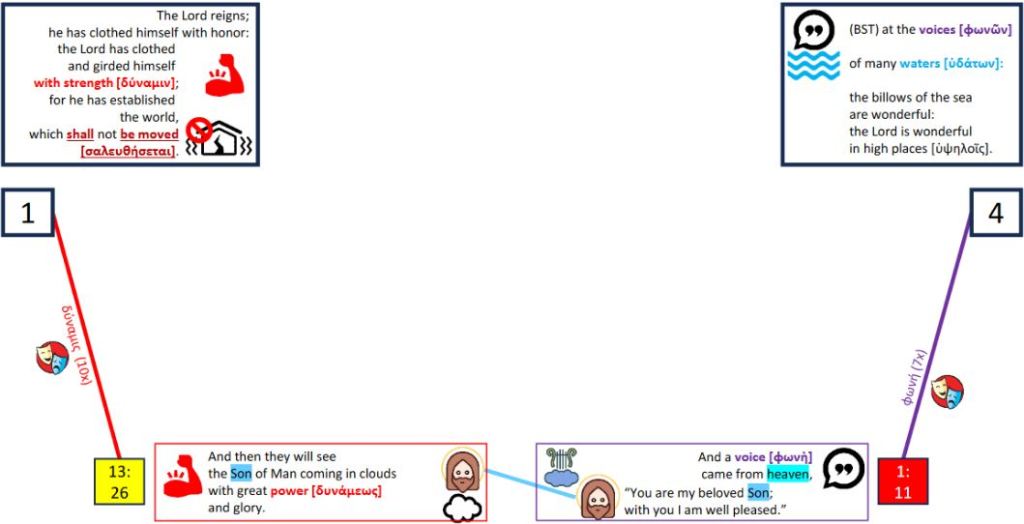
The Son is spotlighted on both sides. “And then they will see the Son of Man coming in clouds with great power and glory.” Let’s see how great power and glory of the Son of Man’s Second Coming parallel the beloved Son’s baptism at the Jordan River. First, great power. The great power is associated to the Holy Spirit who descended as dove upon the Lord. The Holy Spirit is synonymous with God’s power. Jesus referred to the Spirit as power, directing His disciples to “stay in the city until you are clothed with power from on high” (Lk 24:49). “Not by might, nor by power, but by my Spirit, says the Lord of hosts” (Zec 4:6). Just as He promised His followers the power of the Spirit (Acts 1:8), He Himself modeled the way. Jesus our forerunner, the firstborn of many brethren, went down into the waters of death and rose up into a life characterized by the Spirit. He became a curse for us that we might receive the promised Holy Spirit (Gal 3:13-14). So “after that tribulation” the powers of the heavens were shaken and the Power of heaven, the Holy Spirit, descended to earth. “He has established the world, which shall not be moved.” We’re immovable because of the presence of the Spirit!
Second, glory. Glory is the Father’s open praise of the Son: “You are my beloved Son; with you I am well pleased.” This happened again on the Mount of Transfiguration. In recollecting that stupendous event, Peter wrote, “For when he received honor and glory from God the Father, and the voice was borne to him by the Majestic Glory, ‘This is my beloved Son, with whom I am well pleased’” (2Pe 1:17). Peter identified glory as the praise the Father lavished upon the Son. So Jesus appeared with great power—the Spirit’s resting as a dove upon Him—and glory—the Father’s verbalized approval of Him. And just as Jesus gifted the great power of the Spirit to His followers, so too His glory. “The glory that you have given me I have given to them, that they may be one even as we are one” (Jn 17:22). In Christ’s perfect righteousness, we too have the Father’s commendation, “This is My beloved son, in whom I am well pleased.” These gifts, brought about by Jesus’ tribulation that disrupted the powers of the heavens, established the world so that it cannot be moved!
When Jesus was baptized, He went forth in great power and glory. The Holy Spirit enabling one Man was like a cup of water. When Jesus ascended to heaven in a cloud, He then gave the Spirit to the Church that was like a river flowing out to the ends of the earth. When Christ comes again in clouds with great power and glory, that will be like the seas. “The earth shall be full of the knowledge of the Lord as the waters cover the sea” (Isa 11:9).
I’ve alluded before to the blind men and the elephant analogy. As each man groped a different part of the beast, he drew a different conclusion—the trunk as a snake, the leg as tree, the ear as a fan. Today’s partial view of Psalm 93 from Mark’s hyperlinks may feel like groping. But, trust me, once we see the whole elephant at the end, everything will make sense. You’ll have a settled confidence how this Spirit-inspired wordsmithing serves us so well to comprehend more profoundly what Jesus has done for us.
By crafting this chiasm with Psalm 93, Mark interprets Jesus’ baptism at the Jordan River as a parable, not a verbal one as we’re accustomed to but one that’s acted out. This interpretation lets us in on heaven’s secrets. “To you has been given the secret of the kingdom of God, but for those outside everything is in parables” (Mk 4:11). The Lord gives understanding to the seeking heart. So Jesus being baptized in the Jordan River (actual history) has an alongside story (a parable), His death and burial. After that great tribulation, after Jesus arose from those waters of death, there was good news! The sun was darkened; Satan’s rule was diminished. The stars of heaven fell; Satan’s demon army lost its place of authority. The Spirit descended; the Holy Spirit nested upon a blood-cleansed people. The Lord clothing and girding Himself with the garments of cross and tomb was a clothing and girding Himself with power, the Spirit. The peoples of the world, now filled with that same Spirit, are unshakable! What gospel, what good news! Yet as good as this news is, it keeps getting better. Next time we’ll unpack Mark’s Psalm 93:4 hyperlinks with “wonderful” and “high places.”
So Mark’s chiasm gives us fresh eyes to see what’s true. As we believe what’s true, we then progressively experience what’s true. Through death King Jesus has already overthrown Satan and his demons. In the here and now we, the company of the unshakable, have power over the shaken, these fallen powers of the heavens. That’s our rightful place in this cosmic struggle. Today we still fight, “wrestle” as Paul says, but against a defeated foe. They do hinder but do not prevail. At Christ’s Second Coming they will be forever exiled to the lake of fire. So instead of living lives of defeated by the kingdom of darkness, we’re to progressively experience Jesus Christ’s victory on our behalf. Jesus wants to live His servant kingdom of light life through you and me: “The Spirit of the Lord is upon me, because he has anointed me to proclaim good news to the poor. He has sent me to proclaim liberty to the captives and recovering of sight to the blind, to set at liberty those who are oppressed, to proclaim the year of the Lord’s favor” (Luke 4:18-19). Let’s do it!
 Glory Unveiled: Discovering Jesus