I love studying God’s word to know His heart and mind. So I love Bible commentators, whether books or Bible study apps or sermons. Above all this, by far and away the best Bible commentator I’ve ever come across is Mark, the Gospel author. Better than the prince of preachers, Charles Spurgeon. Matthew Henry. Jameson, Fausset & Brown. Better than J. Vernon McGee and David Guzik. Better than the Bible Hub app’s consolidation of commentators. Now, Mark’s way of providing biblical commentary is much different than our modern ways. Mark mimics the ancient literary practices of the Hebrews who authored and assembled the Old Testament. How Mark provides scriptural insights is by crafting the Greek words of his text to sync up to the Greek translation of the Old Testament of his day, the Septuagint. By using a variety of literary techniques (e.g., rare word match ups, symmetry, word plays, etc.), we can plunge into the depths of those Hebrew Scriptures to discover so many fascinating and surprising links that unveil our Lord Jesus Christ!
In my previous blog, we were introduced to the man carrying the jar of water from Mark chapter 14. Mark’s masterful hyperlinking from his Gospel to passages in 2 Kings 18 and Isaiah 30 are an amazingly rich commentary on Jesus that I’d never observed before. I’ve since come to perceive this man with the jar of water as a live action parable about Jesus as the Passover Lamb. Last time we saw how the man depicts Jesus and his jar of water the enormously valuable sacrificial offering of Jesus and all that He had. If you haven’t already, I recommend you visit “The Man Carrying the Jar of Water Explained!” But even without it, you can pick up right here as this blog stands on its own two feet.
I enjoy puzzles. I succeed when I have the box top right alongside all the mixed-up pieces. With that picture of the completed puzzle, I know how each piece positions within the overall scheme. I’m going to show you the box top of a broader literary tapestry that Mark has stitched together for the man carrying the jar of water. Now, at first glance it might feel a little overwhelming. Don’t be discouraged. I intend to unpack this into smaller chunks so you can digest how all these literary links are working together. This box top will take today’s blog and the next two to unpack it. My deepest desire and prayer are that you gain fresh insights into Jesus’ death and resurrection that energizes your faith, increases your love and worship, and transforms your life.
Here’s the box top. Pay special attention to the gold anchors (with gold vertical lines) to highlight Mark’s intention linking to 2 Kings 18:14 and Isaiah 30:14. These gold anchor links unify these storylines from 2 Kings and Isaiah around the person of Jesus and His work of saving humanity.
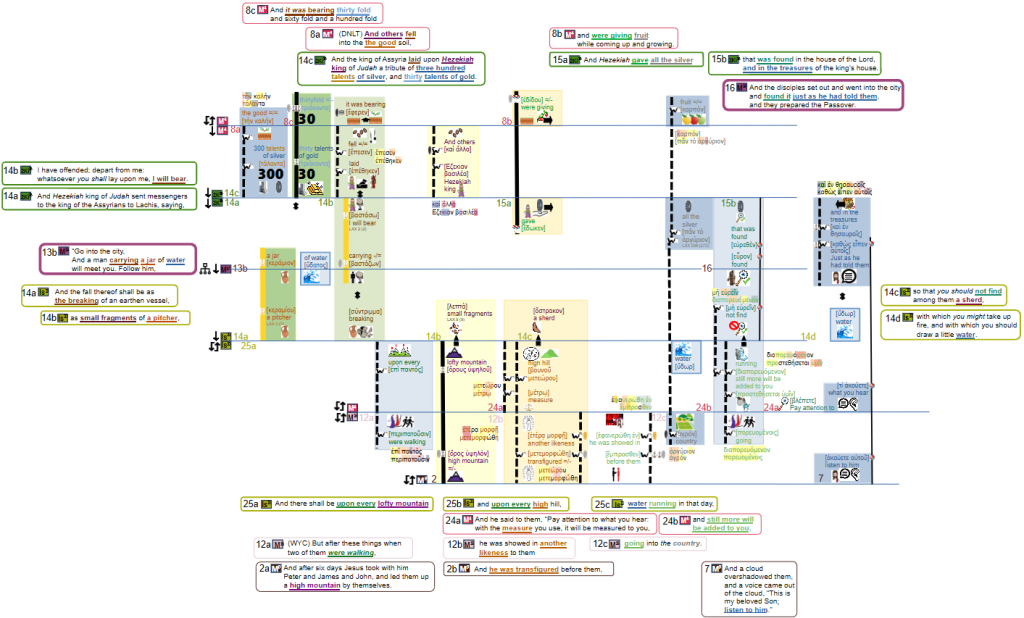
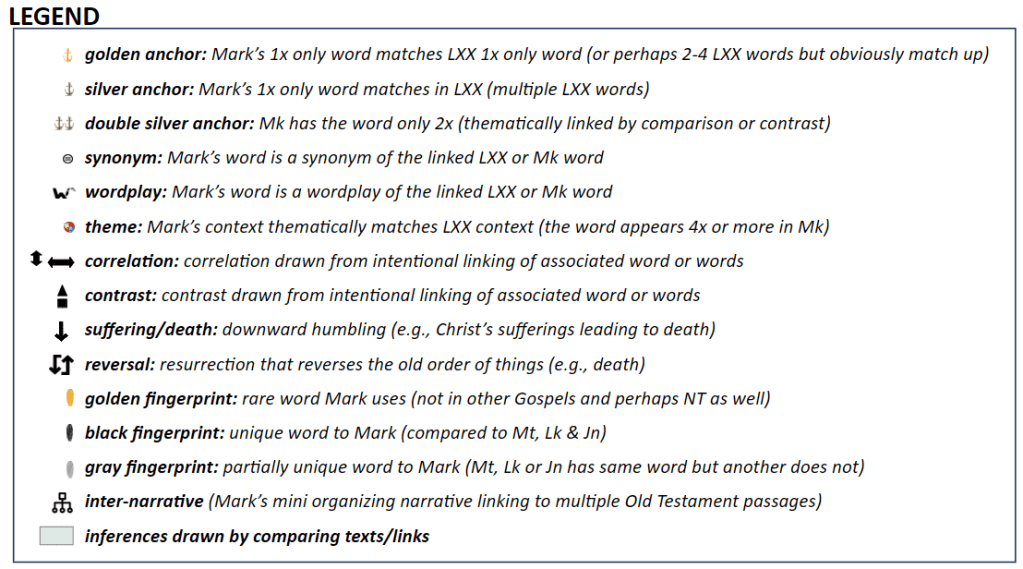
And this is only a fraction of the overall. Believe it or not, it sprawls and sprawls much, much more than this!
Our first look into the box top starts with jar (keramion) linked as a gold anchor to Isaiah 30’s pitcher (keramiou). From this association Mark crafted more associations as shown on the right with Mk 14:16 in the following diagram. You will see many more associations in subsequent blogs.
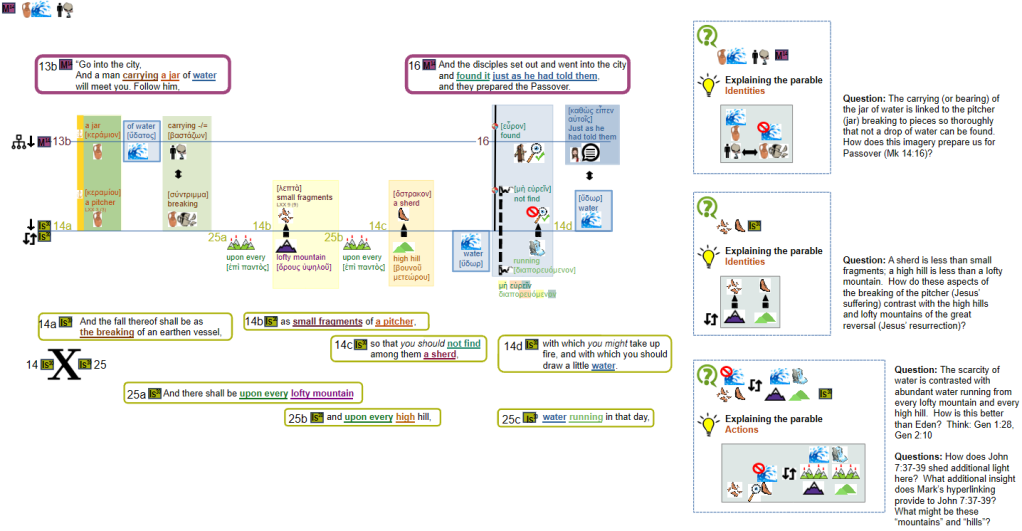
The large “X” in the figure denotes a chiasm. The original Hebrew text of Isaiah 30 verses 14 and 25 form a mirror (chiasm) that actually covers the whole span of these verses. A significant theme on both sides is water, which Mark also ties in with the jar of water. We’ll see much more in the coming blogs on how this chiasm of Isaiah 30 draws contrasts much like a cause-and-effect relationship. The breaking of the pitcher so thoroughly that no water could be found had to happen before the lofty mountains and high hills could be abounding in running water.
Please take a look at the questions in drawing. Thinking through them will help train you to think more as Mark expects of his readers. (He has high expectations!) It is through prayerful meditation that the Lord blesses with understanding (Ps 1:1-3).
These lofty mountains and high hills with running water is imagery way back to the beginning of the Bible. Now, Genesis 2 that introduces us to Eden and its famous garden does not come right out and say it’s a mountain or high hill. That is deduced by the fact that a river parted there into four major rivers. For Eden to have done that, it had to have been a highly elevated place. We all know from experience that water flows from high to low. Isaiah 30 draws from Eden’s mountain with running water image to many mountains and hills with running water. It excels Eden’s single mountain to many mountains and hills!
The Hebrews called running water “living water.” Standing or stagnant water is not living water. It must be moving for it to be “living” water. We know from John’s Gospel (and other references) that living water symbolizes the Holy Spirit (e.g., Jn 7:37-39). The word of God is also symbolized by living waters (e.g., Isa 55:1-3). The Spirit and the word are intricately and perpetually intertwined. So what does Isaiah’s vision tell us about the availability of God’s word and His Spirit? How does your daily experience of God’s word and Spirit match up with Isaiah’s vision? What if you were to truly believe and rest in the generous God of this revelation and not judge Him as a scarcity God because of what you’ve experienced? How might your experience of living waters on a daily basis change?
We’ll take a second look at the box top, this time focusing attention towards 2 Kings 18:14.
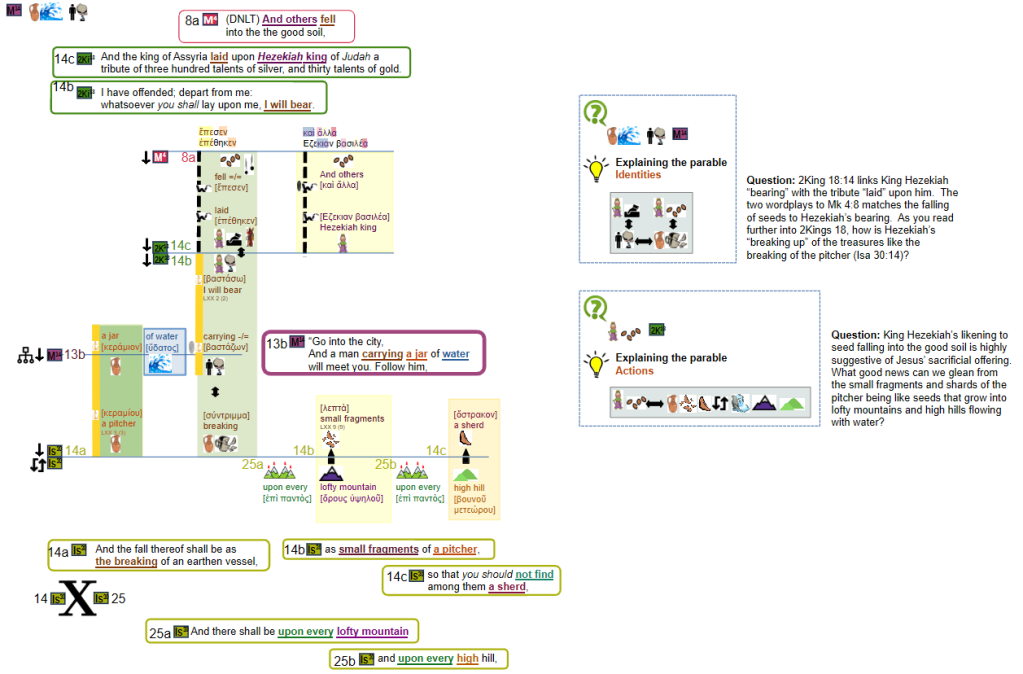
Take a good look at the questions in the figure and try to answer them.
Notice the light green column that pairs up the pitcher breaking to King Hezekiah bearing. These recount Jesus’ suffering as one but see it from two different vantage points. Jesus’ Passover sacrifice was like the breaking of a pitcher. Jesus was so thoroughly shattered to pay the penalty for our sins. Jesus’ Passover sacrifice was also like King Hezekiah’s bearing a ginormous sum of gold and silver, bankrupting the Lord’s temple and the king’s house to pay off the Assyrian king. Mark’s double gold anchors fasten these two scenes together for our consideration.
In the diagram above the light yellow boxes group the seed (“And others”) of Mk 4 and the small fragments of Isaiah 14. When Mark establishes a word play like he does with “And others” and “Hezekiah king,” it is not to be cute or a link merely for the sake of linking. The word play itself means something. What does it mean here? Well, by joining seeds and King Hezekiah, it is pointing to the king’s bearing of the gold and silver tribute like seeds falling into the good soil. Unless a seed falls into the ground and dies, it remains alone (Jn 12:24).
Now take King Hezekiah like falling seeds and compare that with Isaiah 30’s falling pitcher broken into small fragments. These small fragments are like seeds! And what do these seeds grow into? Lofty mountains! That is the resurrection reversal that Jesus did for His people. Because He was like that jar or pitcher that was shattered, its small fragments became seeds that grew into lofty mountains with running water. The small fragments of suffering are the seeds of Eden. Seeds of Eden live in broken pieces. It is through those small seeds that lofty mountains and high hills of living waters populate the earth. And so it is today, ever since Pentecost when Jesus’ resurrection glory is manifesting itself from Jerusalem to Samaria to the uttermost parts of the earth. Peoples from every tribe and tongue and language and people are experiencing these abundant living waters–His presence (the Spirit) and His words. Let us not only marvel at the tremendous cost of the broken Pitcher but also what He purchased–the fantastic abundance of living waters that He offers you and me to freely receive each and every day.
 Glory Unveiled: Discovering Jesus
Thanks Ken, rejoicing in His Word as a seed of Eden. love it.
LikeLike