The Transfiguration isn’t merely a burst of divine light; it begins with a question: what kind of Jesus meets us on the mountain? The scene is brighter than lightning, but the brightness isn’t the point. Something deeper is happening, something that comes into sharper focus when seen through an old crisis and an aqueduct.
Mark isn’t just showing us glory; he’s framing what that glory does. And as those two stories lean toward each other, the mountain stops being just a mountain; it becomes the meeting place where crisis, leadership, and cleansing converge in Jesus. It becomes a doorway into Jesus Himself.
And in the comparison two trios draw attention: three Assyrian envoys and three disciples—Peter, James, and John. They rise as representatives of two kingdoms—kingdoms meant to stand worlds apart in what it means to be human. But they don’t. The spirit of domination and self‑exaltation in the Assyrians gets exposed in the disciples. That Assyrian spirit is not unique to Assyria; it’s common to fallen humanity. Assyria simply exhibits it in a way that lets us see ourselves more clearly. Like a mirror.
That is where the aqueduct and the fuller’s field come in. Mark’s rare reference to the fuller pulls the washing imagery of 2 Kings into the Transfiguration and reframes the moment. Jesus’ glory is not only dazzling—it is purifying. It washes away the grime of self‑rule and prepares His followers for faithful leadership. Fallen humanity like the prideful envoys and Peter, James, and John are precisely the kind of people Jesus came to cleanse and form. This Servant‑King conquers, but never by Assyrian tyranny.
The mountain crests with Jesus Himself — not just light, not just cleansing, but the Lord of glory standing before them. And only then does the aqueduct image rise, not as the star, but as the shadow that points to His substance: the living One through whom the water of life flows to His people. The metaphor bows; the Man shines. The same Jesus who was transfigured before the disciples is still the one whose glory washes us, reshapes us.
But Jesus’ glory does more than even that — it draws us toward Himself. The radiance that washes away everything Assyrian in us is not a destination but a doorway. Once His radiance begins to steady you so that your life shines, you might think you’ve arrived. No. The washing is wonderful, but it’s not the treasure. It’s preparation for the treasure. Jesus would later say to Peter, “If I do not wash you, you have no share with me” (John 13:8). The treasure is the One whose light does the washing.
And that is where we pick back up. We must follow Mark’s lead from washing to something even more wonder-filled. We must see how the old story paired with the new story points toward the best gift, the best destination—Jesus Christ Himself.
But how do I get there? I know it’s rest. I know I can’t earn it. I know I’m supposed to receive. Is there something more specific that helps me experience the mount for myself? Yes. To know that path, we have to fast-forward to Peter as an old man, looking back on the mountain and giving us the clues we need.
Now the question becomes practical: what do I do with a glory like this? The mountain is not meant for show; it unveils what kind of Jesus meets us there. He’s the One who reveals Himself to reshape us—not just in the “not yet,” but now.
Unhinged—and the Hidden Hinge
First, the crisis at the aqueduct. The mighty Assyrian army had swallowed up all Judah; Jerusalem alone stood. The city trembled while the empire’s three top representatives took their stand where the water spills toward the Pool of Siloam. “And when they called for the king, there came out to them Eliakim the son of Hilkiah, who was over the household, and Shebnah the secretary, and Joah the son of Asaph, the recorder” (2 Kings 18:17–18 ESV).
From crisis, the movement becomes a cry. Before the Assyrian spokesman’s boasts and jeers begin, two small phrases begin to gleam together: “they cried to Hezekiah” (i.e., “they called for the king”) and “there came to him.” At first, they seem unrelated, but the more we linger, the more we feel them leaning toward each other.
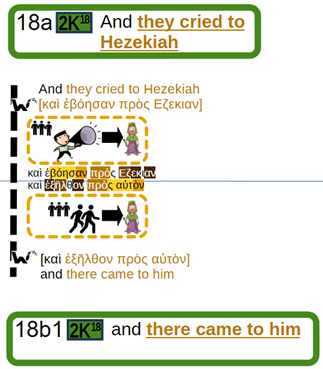
From Hebrew to Greek ‘them’ subtly shifts to ‘him.’ The Hebrew says Jerusalem’s stewards came ‘to them’—the three envoys. The Greek says ‘to him’— either back to Hezekiah or forward to the Assyrian spokesman. And since the stewards did first go to Hezekiah (18:36), this tiny shift lets the two trios begin to hum like notes in harmony. Two trios — one proud, one obedient — stand in the same frame, both drawing toward the king.
Then Mark sharpens the frame. This seemingly random echo leans the story toward transformation. A new trio — Peter, James, and John — rises beside the old story’s two trios — one filthy, one faithful. The disciples, tragically, stand with the filthy. Now here’s where Mark sharpens this frame up a notch. What comes into focus is activity. The envoys cry rises beside Jesus’ clothes becoming radiant.
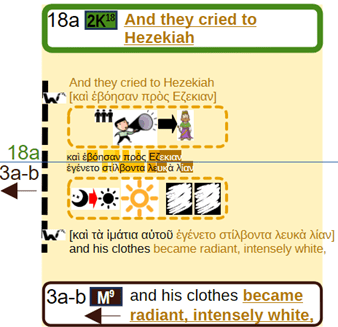
The Greek letters of ‘they cried to’ mimic ‘became radiant.’ The echo suggests a link between crying out and becoming radiant. Hezekiah’s name—edz-ek-EE-on—and the words for ‘intensely white’—le-ook-EE-on—briefly rhyme. It’s a small echo, but enough to slow the story and let the moment sharpen. The name is tied to the brightness. Crying to that name is tied to becoming bright. The comparison is not accidental. Here, where the old story meets the new, the glory of Christ breaks wide open. The cry of the envoys—filthy—are side by side with Jesus’ intensely whitened garments—clean. Standing next to the humble, radiant Galilean are proud Peter, James, and John — echoes of the proud Assyrians.
From cry, Mark leads us into cleansing. You can almost feel something turning — not a mechanism, but a mercy. The glory transfigures more than cloth. The cry of the unclean is met by washing unto whiteness. Mark’s focus on garments whiter than any fuller could bleach opens a Person. The cry is met by the new king doing what the old king never could: bleach unclean hearts to become intensely white, as no one on earth could do. As Jesus stoops to hear the cry of soiled hearts, His radiance begins its work. This is simply what happens when our cry draws Jesus close.
The center must shift from Hezekiah — who cannot save — to Jesus — who can cleanse to the uttermost. The fuller’s field and aqueduct help us see the cleansing, but they are shadows. The substance is Christ. The old waters washed clothes. The new radiance washes hearts. A new humanity stands transfigured, one washed from Assyrian ways of self-exaltation. And when our cry rises, the old aqueduct ends up sharpening how we see the living Christ, whose glory reaches the places we cannot fix.
As Mark’s narrative goes on, we see that this scene didn’t transform Peter, James, and John — not yet. In fact, their conqueror instincts only swelled. James and John vied for seats of power next to Jesus. Peter boasted like an Assyrian, “Though all forsake you, I never will.” Their spiritual blindness at this moment stifled their cry to the King they desperately needed to wash them.
It’s in the ache of desperation that oftentimes the turning begins. The Assyrian spirit is not too hard to spot — the rivalry, the pride, the quiet ways we maneuver our spouse, our children, our coworkers, our brothers and sisters in Christ. Sometimes the Spirit lets us see it with a clarity that startles us. But the sight itself is not the cleansing. It is the invitation. If you feel exposed here, that’s not failure — that’s the Spirit opening the door. The ache wants to become a cry. The Assyrians’ cry rose in pride to intimidate the king. Our cry is meant to rise in humility — not pushing, but pleading — to invite the King. And when that cry rises, the radiance on the mountain is no longer just a scene we read about.
The radiance on the mountain is not a spectacle of superiority; it is what happens when heaven opens around Jesus. His garments blaze beyond anything a fuller could bleach, yet the brilliance is only the overflow of the One standing before them. And as the old story shimmers beside this moment, we watch the living waters of His presence undo what domination once shaped — the Assyrian grime loosening, the rivalries quieting, the self‑exalting ways falling away. And something in you knows this radiance is meant to reach you too.
If Peter, James, and John had stayed Assyrian, the church they would one day shepherd might have calcified into something cultlike — elevating celebrities, excluding those who “don’t follow with us.” But the radiance meets them first. It cleanses before it commissions. And in that washing, the mountain whispers the kind of people Jesus is forming — not the superior, but the purified; not the self‑exalting, but the self‑abasing, those who lose their lives for Jesus’ sake and the gospel’s.
This Mount of Transfiguration is crucial. This is not just ancient history. We need that kind of glory‑encounter today. It spells the difference between our lives remaining common cloth—indistinguishable from the world—and becoming garments bleached whiter than any bleacher on earth could ever whiten. And yet even that whiteness — our shining testimony to the world — is not the end.
How do we experience the King’s glory breaking in and reshaping our shame into shining? It begins the same way it did at the aqueduct: we cry out to the King. We pray. We not only feel our desperate need—we confess it to Him. And then what? The movement is wonderfully simple.
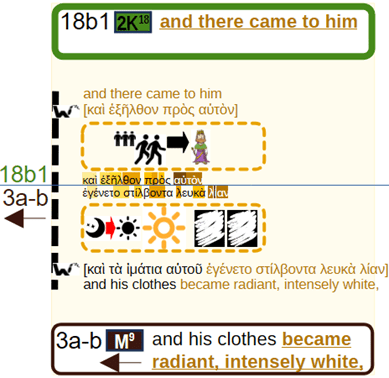
And then we come. Just as Mark echoed the radiant moment to the Assyrian cry, he echoes it with the city leaders’ coming — “and there came to him.” The same shining that met the cry now meets the coming. As Hebrews says, “The one who approaches God must believe that he exists and is a rewarder of those who seek him.” Crying out opens the door; coming to Him brings us into His marvelous light that changes us.
The King does not merely wash His people. On the mountain as Jesus stands speaking with Moses and Elijah, the wave begins to rise again toward a glory we have not yet seen.
Friends, Not Servants
Mark lets the scene slow for a moment, as though he wants us to notice something quiet rising beneath the radiance on the mountain. Elijah and Moses stand beside Jesus — three figures who bore a nation’s crisis in their own day. And their names begin to hum with a faint resonance to those who once stood trembling at the aqueduct — Eliakim, Somnas (aka Shebnah), and Joah.
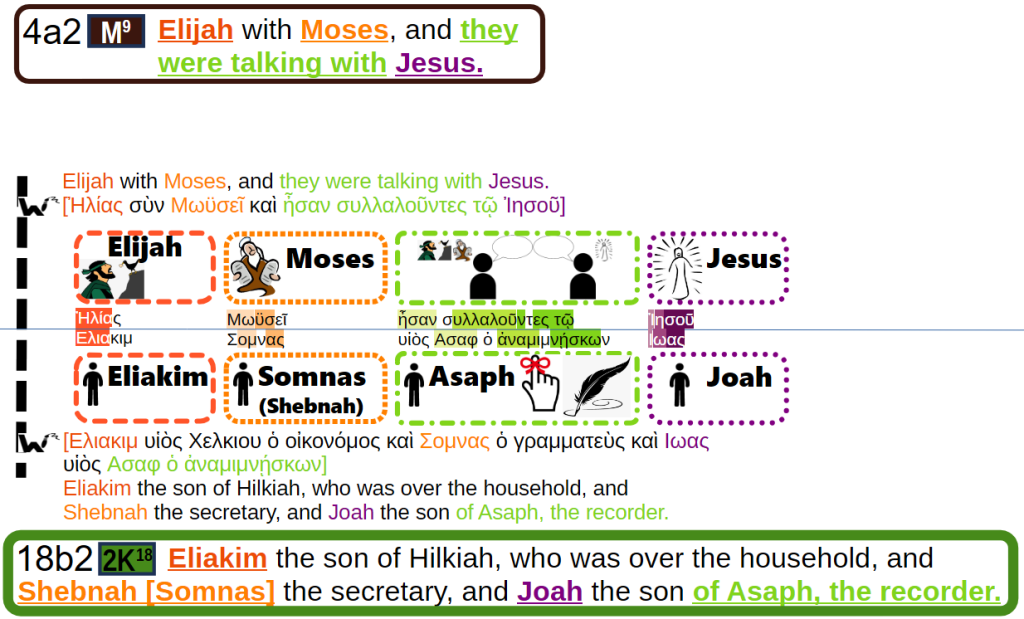
As you linger, the names begin to reach toward each other — Elijah beside Eliakim, Moses beside Somnas, Jesus beside Joah — Iēsou (EE‑ay‑soo) and Iōas (EE‑oh‑oss). The mirror softly invites a closer inspection. Mark’s ordering of the names — much different than Matthew’s and Luke’s — lets notes ring in a chord you didn’t expect to hear, a faint resonance tuning our ears toward Jesus. And when the echoes gather, we see two trios. Two humanities standing side by side.
If you lay the names side by side, a quiet correspondence rises — not to impress us, but to draw our eyes toward the One whose glory is the center.
| Person (Mark) | Judah’s Envoy (2 Kings) | What the echo invites us to notice |
| Elijah | Eliakim | Sound-echoes; pairs Elijah with the household overseer |
| Moses | Somnas | Ordering + sound-echoes; pairs Moses with the secretary |
| Jesus | Joah | Ordering + sound-echoes; pairs Jesus with Joah the recorder |
The mirroring of Elijah, Moses, and Jesus with Eliakim, Somnas, and Joah steers us to ponder what a cleansed humanity looks like — figures who stand beside the King in fellowship instead of crowning themselves. And the point isn’t the symmetry. The point is the Man at the center. Jesus is the One who’s forming a people who can stand beside Him.
But the symmetry doesn’t stay there; it gets bigger.
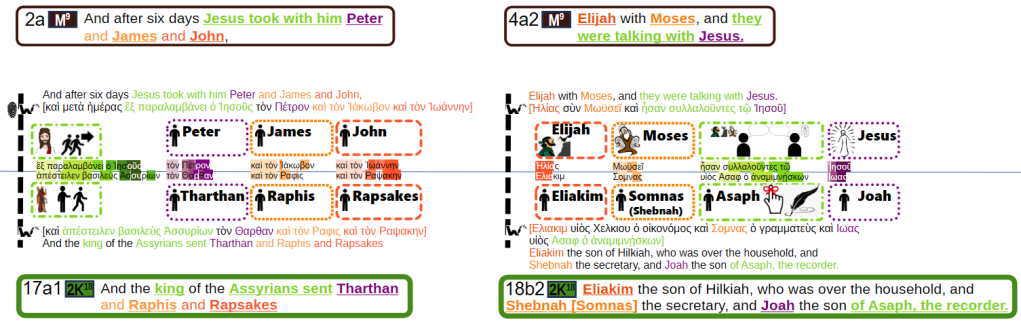
Mark’s arrangement lets the mountain echo the aqueduct. They went up one way, but the scene that meets them at the top — Elijah and Moses talking with Jesus — hints at the way they are meant to come down. Peter, James, and John went up reflecting the same old grime as their Assyrian counterparts. That was the very condition that cried out for the fuller’s field. Out of the crisis came desperation, and out of desperation a cry, and out of that cry a radiance that washed them clean — and from that radiance, a conversation with the King. A crisis has become a conversation. That’s how Peter, James, and John were meant to come down. The mountain reveals not only Jesus’ transformation but the disciples’ as well. It is not just a scene; it is an invitation.
This mirror glows only because Jesus stands within it — the symmetries matter only because He fills them. The story begins with Jesus taking His disciples up the mountain, and it culminates with Jesus talking on the mountain. Between the taking and the talking lies the moment that changes everything. Mark wants us to feel the weight of that middle moment. That’s why he introduced that rare fuller word that Matthew and Luke didn’t. What lies between taking and talking is the radiant moment. Everything pivots around that. That radiance bleaches not just clothes but people. Jesus’ glory flows like water through an aqueduct, loosening everything Assyrian within. Something old is undone, and something new begins to whiten.
And now Mark’s camera turns toward the two figures who stand beside Jesus, as though he wants us to see the cleansing in living color. Moses and Elijah aren’t just there as representatives of the Law and the Prophets; they are men with stories — stories shaped by the same Assyrian‑like impulses we’ve just traced. Moses once struck the rock in a spirit of domination — “Must we fetch water for you?” Elijah once stood in the boast — “I alone am left.” These were the very sins that marked their crises.
And now the story turns toward fellowship. Elijah and Moses stand on the mountain, washed and home at last. Moses, who never entered the Promised Land, now stands in the land with the Promised One. Elijah, who once despaired of being the only faithful one, now stands in fellowship with the Faithful One. The Aqueduct’s cleansing has reached them too. Moses’ domination is gone. Elijah’s boast is gone. Elijah and Moses stand beside Jesus, not as ornaments to the scene but as living proof of what cleansing is for. The mountain is no longer only about garments; it is about companionship, conversation, and the restoration of a shared life with the King.
And suddenly the scene becomes a picture of what Jesus wants to do with Peter, James, and John — and with us. What Jesus did in Moses and Elijah, He went on to do in His disciples. Before, shaped by Assyrian ways, they sought their own glory. Afterwards, they sought His. James became a martyr. John endured exile on Patmos. Tradition says Peter was crucified upside down for his Lord.
So Jesus’ glory is not only dazzling — it is purifying. He is the true Aqueduct, the living channel through whom the cleansing and life of God flow to His people. His glory washes away the grime of self‑rule. And glory now moves from clothing to communion, from shining garments to shining companions. Once‑common men are enjoying uncommon fellowship with Jesus. We need His glory to wash us, reshape us, and lead us into rest. The new story gives us the best gift and the best destination — Jesus Christ Himself.
Remember why we’re comparing the mount with that old story in 2 Kings? That rare Greek word — bleacher, fuller — was Mark’s breadcrumb that led us here. He deliberately invoked the fuller’s field — the place of washing — through Jesus’ transfigured garments. The laundromat seems to be the lens Mark wants us to hold as we watch the Transfiguration unfold. It’s not the only lens — Matthew has his angle, and so does Luke. Luke alone tells us what the conversation was about: Moses and Elijah “spoke of his departure, which he was about to accomplish at Jerusalem” (Luke 9:31). But for Mark, the emphasis is not what they spoke but that they spoke. It is the conversation itself that matters — Jesus standing in fellowship with Moses and Elijah, speaking with them as friends.
And a detail Matthew and Luke highlight, Mark simply leaves in silence: Jesus’ face shining like the sun. He says nothing about it. It’s striking footage to leave on the cutting‑room floor for such a moment.
Why might that be? This isn’t the only way to read Mark’s silence, but perhaps the glory has less to do with physical light and more to do with Scripture’s face‑to‑face moments. “The LORD would speak to Moses face to face, just as a man speaks with his friend” (Exodus 33:11). And the result? “Moses did not know that the skin of his face shone because he had been talking with God” (34:29).
Shining and talking — it’s a pattern we’ve seen before. And it’s hard not to hear an echo of Eden here — God talking with His people again. In the garden, before shame drove them behind the trees, Yahweh would come walking in the cool of the day — to talk with them. That fellowship was lost, and every echo since — Moses’ shining face, the mountain’s radiance — points to the same truth: glory is relational because Jesus is. Jesus shines to restore Eden’s forgotten fellowship.
Each time He reveals His glory, it eclipses shame and makes His bride radiant. And the mountain whispers that the story God is telling — from Eden to the New Jerusalem — is the story of a Bridegroom who will not rest until His bride walks with Him again. Fellowship is His reward.
The glory on the mount invites us to see the shift from servant to fellowship. From striving to relaxing. From domination to communion.
Jesus said it plainly: “No longer do I call you servants… I have called you friends.” (John 15:15)
When Memory Becomes Revelation: Meeting Joah
Finally, we need to return to a man in the old story we just rushed past yet quietly reveals what Jesus treasures. His name is Joah. His role is easy to overlook. He stands in the shadow of kings and commanders, yet his presence may yield one of the richest insights into Jesus on the mountain — what moves His heart. In this confrontation between the Goliath‑empire and the shepherd‑boy nation, Joah stands not as a warrior or a strategist. He’s simply the recorder.
At the aqueduct crisis Joah does not speak while the Assyrian spokesman hurls his boasts. He does not negotiate. He simply stands there, listening, remembering. Beside him, Somnas the secretary writes it all down. Joah is safeguarding what is precious in the moment, holding the words that matter, carrying them to the king. He is the keeper of memory — the guardian of what must not be forgotten.
We know something of this instinct. We take pictures. Sometimes we go overboard — no one needs a selfie of last night’s spaghetti. But watch people when a grand rainbow arcs across the sky, or a sunset sets the horizon on fire, or the Grand Canyon opens before them — they reach for a camera. Some moments are worth remembering.
And when Mark gently mirrors the old and new stories, something about Joah the rememberer begins to glisten beside Jesus on the mountain. Not a doctrine. Not a category. A whisper. A suggestion. Our eyes gradually turn from Joah toward Jesus and glimpse something tender about Him. It wouldn’t be unlike God to weave an ordinary decision like Hezekiah’s choosing of Joah into extraordinary echoes. And God — if you haven’t noticed by now — loves to showcase His Son.
Scripture has its own way of talking about remembering. When God remembers, things move — flood waters recede, barren wombs open, promises step forward. But the remembering that glimmers beside Joah is different. It isn’t God reaching back to something He said long ago. It feels more like God leaning toward something happening right now. A moment worth treasuring. A moment worth holding.
And when we return to the mountain with Joah in mind, the picture sharpens. After the radiance, what do we find Jesus doing? Not commanding. Not conquering. He is talking. The One who shines is also the One who listens, the One who holds the moment. Moses and Elijah converse with Him as friends, and the scene feels less like a throne room and more like a table — a restoration of something ancient and beautiful. And the good news is that this is not just for prophets on mountains — this is for ordinary disciples like us.
Joah’s quiet name‑echo is still humming, deepening the wonder of Jesus as He shines. Jesus is not storing up a promise to fulfill someday. He is treasuring a moment. Holding it. Cherishing it. Talking with Jesus is no insignificant act of kindness to Him. His face shines. It is worth writing down. This is what His heart longs for. If Jesus ever pulls out His iPhone for a selfie, it is when He is in conversation with His people.
At first connecting Joah with Jesus felt small to me, almost too small to matter. Peculiar even. But the more I asked the Spirit about it and meditated on it, the more it began to make sense. Not long after the mount, Jesus said, “For truly, I say to you, whoever gives you a cup of water to drink because you belong to Christ will by no means lose his reward” (Mark 9:41). It is Jesus’ remembrance of a small, seemingly insignificant act of kindness that results in future reward.
Another story lets us in on this heart of Jesus. It’s the night a woman—Mary of Bethany—slipped into a room with an alabaster jar, broke it, and poured a year’s wages worth of fragrance over the Lord’s head. The disciples scolded her for the “waste,” but Jesus called it “a beautiful thing to me.” And then He did something very Joah‑like — He held the moment. He said it would be remembered wherever the gospel is told. Not simply because the gift was costly, but because the giver was precious to Him. A moment He didn’t want the world to forget.
Somewhere along this climb — somewhere between the aqueduct’s crisis and the mountain’s radiance — a quiet figure has stepped forward. Joah. The recorder. The one holding the camera. The one who kept the moments that mattered to the king. And when you hold Joah beside Jesus long enough, something begins to stir. His presence becomes an unassuming window into Jesus’ heart. A contemporary worship song has a simple and piercing refrain: “Tell me what moves You.”
Is it a fragrance? Then I’ll pour my oil out.
Is it a life laid down? Then here I give my vows.
Is it a song I sing? Then here’s every melody.
Just tell me what moves You.
“Move Your Heart” by Maverick City Music & Upperroom
Joah’s and Jesus’ names echo each other like a quiet song that unobtrusively draws Joah’s role — recorder — into its melody. And in that tune, a deeper resonance begins to rise—Jesus Himself is the true Recorder of moments like this conversation with Moses and Elijah. It resonates tenderly — faint, but enough to steady the heart. The King who shines is also the King who remembers — the One who delights in dialogue, not in those who grasp for crowns or perform for Him. And once we see this — that Jesus treasures conversation — the whole story comes into focus.
We began in crisis — at the aqueduct, where the Assyrian spirit exposed the gunk within us. We heard the cry — the desperate plea of a people who could not save themselves. We watched the cleansing — the glory‑washing of the true Aqueduct, radiant and giving. And the radiance does not push Moses and Elijah away. It used to — but not anymore. It’s not His back Moses sees now, but His face. Elijah’s face is no longer cloaked. Now they stand face-to-face with the King as companions. Friendship is not ultimate; the mountain shouts that Christ is, but friendship is the reward He died to give. The fellowship is precious because the infinitely precious One who bore our sins did so to restore fellowship lost.
It’s about the fruit of what His glory came to accomplish — a people who were once darkness but are now light to enjoy conversation with Him. That’s what moves Him. He treasures even the smallest acts His people do in His name, not only the big ones like when Mary broke the jar. Before Jesus channeled waters that washed our hearts, everything was about what would make us happy, what would build our name, what would make our moment memorable. Afterwards, everything becomes about what would make Him happy — what would make a memory for Him. What lingers with Him is being near, talking and listening.
The mountain scene is not only about lightning-bright light, a clean heart, and a shining testimony to the world. Remembering, too, is not the center of the mountain. He is. It is about a King who cherishes the everyday conversations of His saints. He writes them down. He holds them close. He never forgets. Friendship is the mountain’s gift. This is the wonder we’re invited to receive.
And when you’ve been cleansed, a longing awakens. What would it be like to live in that kind of nearness? To become the sort of person whose moments with Jesus are worth holding? When Jesus is unveiled — the Aqueduct whose glory cleanses and the Recorder whose heart delights to speak with you — the whole scene becomes an invitation. Not with pressure, but with possibility.
Jerry Bridges used to ask, “Yes, but how?” whenever he read Scripture. You may feel the same tug: Yes, Jesus as the Aqueduct and the Recorder sounds wonderful — but how does that wonder become mine? How do I experience my own transfiguration moments? I know it’s rest. I know I can’t earn it. I know I’m supposed to receive.
How? There is something more specific. And it’s more textured than the well-worn “pray and read your Bible” answer we often reach for. To see it, we must travel forward in time to Peter as an elderly man. Looking back on this moment with the wisdom of years, he offers the very steps that open us up to Jesus’ glory. And this is no mere matter of academics. Recall that the mountaintop didn’t change Peter, James, and John — not yet. Their Assyrian‑like instincts to be number one whether by grab—James and John— or by brag—Peter—only got worse.
There is a way of seeing the Mount of Transfiguration that doesn’t transfigure anything. If we look with those eyes, we won’t be changed either. It was only after Jesus died, rose, and ascended that Peter finally learned the lesson — and finally tasted the exquisite beauty of the Transfiguration in his own life. The fumbling disciple on the mountain had become a seasoned shepherd, guiding us toward glory. If we overlook him, we miss the blessing. We need this wiser Peter to help us connect the mountain to our own encounters with the living Christ.
P.S. If your heart enjoys seeing the quiet architecture (I like to call it “artitecture”) beneath a passage — the way old lines hum beneath new ones — I’ve included a visual “box top” of Mark’s symmetries below. It’s not needed to follow the main story, but for those who love tracing the Spirit’s fingerprints in the text, it may deepen your wonder. If you choose to explore it, linger where the echoes meet and let the Spirit draw your attention where He will.

 Glory Unveiled: Discovering Jesus