The Mount of Transfiguration: More Than Meets the Eye
The Mount of Transfiguration is a scene we think we already know. It’s a breathtaking divine exclamation point — heaven breaking open around Jesus. But tucked inside that moment is something about His glory I’d never noticed. And once I finally saw it, I saw Jesus breaking open heaven around me.
It changed how I see Jesus and how I see myself. I don’t have much free time — a full‑time job, a wife, two teenage sons, and a heart that longs to write more than my schedule allows. But this study has so deeply affected me — enjoying Jesus daily and what’s at stake — that I had to share it. And what’s at stake is not only our peace and joy but Jesus getting what He deserves by ordinary lives getting lit up by His glory.
And that’s why the Transfiguration isn’t just their story — it’s the pattern for ours. It puts us right beside those three disciples, learning a new path on that mountain. Glimpsing Jesus’ glory does more than shine. It cleanses. It prepares.
So get ready to trek up this mountain — and with the binoculars of Mark’s Greek in hand — watch what new glimpses of Jesus begin to come into focus. As his clues sharpen into view, overlooked connections emerge: glory and cleansing, leadership and washing, and weakness and wonder.
A Crisis of Leadership — Then and Now
Before we climb further, we need to step into a moment in Israel’s story — a flashback Mark uses to help us behold Christ on the mount more penetratingly. He opens an older story to draw us deeper into Jesus Himself, stitching the threads of the old and the new until the blinds are pulled open on what’s been there all along. So before we stand on the Mount of Transfiguration, we first stand on another mountain, another crisis, another moment in Israel’s past. The connection isn’t obvious at first, but once the Lord opens your eyes, you’ll never read Mark 9 the same way again.
To understand Mark’s intention, we have to stand for a moment in 2 Kings 18. Judah is under siege, Jerusalem is the last city standing, and the great empire of Assyria sends three men — three kingdom shakers, three representatives — to confront a trembling city. They come with intimidation, with self‑exaltation, with the full weight of their empire behind them.
When Jesus goes up the mountain, He also takes three with Him — Peter, James, and John. In the old story, three figures stand before a threatened mountain city. In the new story, three stand with Jesus on the mountain. The scene is now set: three envoys, three leaders, and a city under pressure. And that raises the real tension: why would Mark want this crisis to crest right here in the climb? It seems he’s letting the pressure build before the light breaks. Before God unveils glory, He often unveils need.
That’s where his next clues come in. Mark begins to weave quiet wordplays between this moment and 2 Kings 18. It’s one way how Scripture reveals Christ. He isn’t inventing clever parallels; he’s drawing on ones already woven into the Greek. Catch the wonder of it.
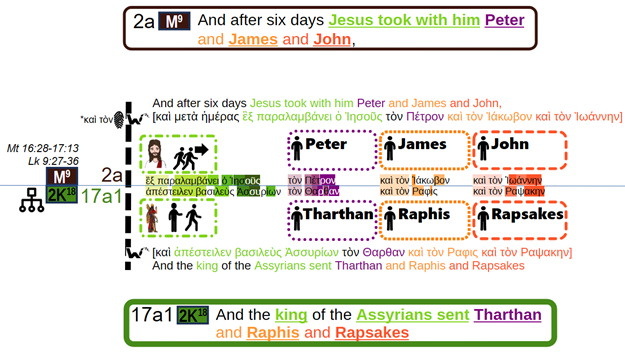
One of the most striking clues is how Mark lines up Peter first, James second, and John third in a way that mirrors the three Assyrian envoys. Once you notice the ordering, the sound-echoes in the Greek begin to bubble up through the English. The Greek feels alive — musical. Letters fall into place like notes in a melody, like rhymes in a poem. Say the names aloud in Greek and you can hear the consonants and vowels reaching for each other — Πέτρον (Petron) brushing up against Θαρθάν (Tharthan). The other name pairs carry their own soft humming. It’s subtle, but once you hear it, it’s hard to unhear. It took me a while to orient myself to Greek sound-echoes, so don’t worry — the point is simply that Mark wants us to feel an echo.
The second clue is even more telling. You don’t need to remember the grammar; just notice Mark does something unique here. When he lists James and John, he inserts ton—“the”—an extra definite article he never uses in any other Peter‑James‑John grouping (5:37; 13:3; 14:33) nor do Matthew and Luke. It’s unnecessary grammatically, but it mirrors the Septuagint (Greek Old Testament) wording of the Assyrian scene with striking precision.
Taken together, these hints invite us to see a three‑on‑three parallel:
| Disciple (Mark) | Assyrian Envoy (2 Kings) | Why the echo matters |
| Peter | Tharthan | Sound-echoes; pairs Peter with the general |
| James | Raphis | Ordering + phonetic echoes; pairs James with the chief eunuch |
| John | Rapsakes | Sound-echoes; pairs John with the herald/chief cupbearer |
Mark seems to be presenting the three Assyrian envoys as a deliberate parallel to Jesus’ three kingdom builders. It strongly suggests that these disciples are stepping into similar roles as the envoys. The Assyrian traits of domination, intimidation, and self‑exaltation are superimposed onto Peter, James, and John. And the uncomfortable truth is this:
Peter, James, and John carry more of the Assyrian spirit than we’d like to admit.
And Mark has been hinting at this from the start:
- Peter “casting a net into the sea” isn’t just a snapshot of his day job — it quietly echoes Assyrian conquest (see my blog “What Kind of Fisher of Men Am I?”).
- Shortly thereafter Peter embodies the Assyrian spirit with katadiōkō—“they hunted him down.” Mark recasts the wild animals as wild disciples: predators tempting Jesus to serve their agenda.
- John forbids others from casting out demons because they “don’t follow with us.”
- James and John want the seats of glory at Jesus’ right and left.
- Peter boasts he’ll stand firm even if everyone else falls away.
These are not the instincts of shepherds. They are the instincts of conquerors. Let that settle. These are the men Jesus is about to wash.
What animates the Assyrian envoys — rivalry, pride, and domination — also animates the disciples. This is the exact opposite of Jesus, who taught, “whoever would be first among you must be slave of all. For even the Son of Man came not to be served but to serve, and to give his life as a ransom for many” (Mk 10:44–45). Here’s the real tragedy. These conqueror instincts don’t just blot out the self‑emptying love of Christ — they prefer the darkness of self‑exaltation over the beauty of His humility. Peter, James, and John are a sobering mirror for us to see ourselves — not to condemn but to help. And we don’t have what it takes to cleanse or reshape ourselves.
Jesus has a problem on His hands. He loves the world. He has come to rescue it from sin and Satan. He intends to build a church the gates of hell cannot withstand.
But His builders are not yet ready. They are strong—but with the wrong kind of strength. They are leaders—but with the wrong kind of spirit. The Assyrian impulse to dominate, boast, and use words as weapons still beats in their hearts.
And this is where the crisis reframes the Transfiguration. It is not merely the reveal of Jesus’ radiance; it is the moment His glory stills the driving winds and swelling waves inside His own disciples so a new kind of servant‑leader can be born.
Mark isn’t simply showing us glory; he’s showing us the kind of leaders Jesus is forming. It’s these types of leaders who will present the church as a pure virgin to Christ.
Suddenly the Transfiguration becomes a life preserver. It’s not just theology; it’s survival. Mark is steering this scene out of crisis by letting the old story and the new story crash together in a way that signals the path forward.
“They Went Up” — The Mountain and the City
The scene is in place, but the real surprise is still waiting in the geography — the place where Mark’s mountain meets Israel’s city. In 2 Kings 18:17, the three Assyrian envoys “went up and came to Jerusalem.” In Mark 9:2, Jesus “led them up a high mountain.”
Mark is drawing on a pattern woven into the biblical story long before his Gospel. And the next clue does not add to the picture; it changes what the picture is about — from a mountain for three to a city for all.
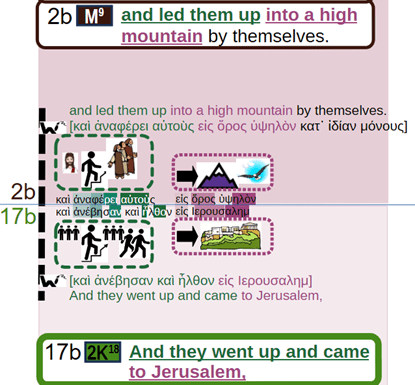
This is just a small slice of a larger sequence of verse‑by‑verse wordplays Mark crafted between these two passages. “And led them up” and “and they went up” share a natural pairing. Both scenes involve an ascent, and the Greek phrasing echoes that similarity.
The next pairing — “into a high mountain” and “to Jerusalem” — is subtler. This is where Mark’s literary “binoculars” help us focus. The Greek for “mountain” (ah‑ROSS) gently echoes the sound of “Jerusalem” (eh‑ROOS). Even part of the word “high” (ay‑LON) resonates with the “alem” in “Jerusalem.” These sound‑echoes aren’t meant to prove a one‑to‑one correspondence; they’re soft allusions. Mark lines his narrative with these quiet hints, nudging us to see how the mountain and Jerusalem belong together in his imagination.
The Mount of Transfiguration was a high mountain. Jerusalem, too, rose like a mountain — the city of God. The mountain moment illuminates the meaning of the city, and the city illuminates the meaning of the mountain.
But Jerusalem is not ultimately defined by buildings or geography. Beyond its stones and streets, it stands for the people of God. And if you trace its story all the way through Scripture, you eventually reach the breathtaking summit in Revelation: Jerusalem is the bride, the wife of the Lamb (Rev 21:9). Jerusalem is about people — people from every tribe, tongue, and nation across every era. It’s about you and me.
With that in mind, the mountain begins to shed light on the city. The Mount of Transfiguration is not only a moment for three apostles or even for future Christian leaders. In the larger biblical story, it speaks to the whole people of God—the Jerusalem of His redeemed, the people who are His. If the symbolism feels vast, that’s because Scripture is opening a ginormous story — one that’s hard to take in all at once.
And when we place the mountain and the city side by side, another marvelous reality comes into view. The mountain shows us what the city becomes — transfiguration. The completed people of God—the city purchased by His blood (Rev 21:10)—are the very place where God reveals Himself among His people. And what is true of the whole is true of each one within it. He reveals Himself — His glory — to you and me.
So both scenes involve:
- Three representatives
- A going up
- A confrontation with glory
- A crisis of leadership
The clues so far reveal a deeper crisis: the disciples are entangled with Assyrian conqueror instincts. And this next detail in the old story pushes that turn even further — toward water and washing.
The Aqueduct and the Fuller’s Field
In 2 Kings 18:17, the Assyrian envoys stand ‘by the aqueduct of the upper pool, on the road to the fuller’s field.’ That detail is anything but random.
Jerusalem’s defensive strength lay in its water supply. The city was fed by the Gihon Spring — the ‘upper pool.’ Hezekiah later engineered an aqueduct to divert that water through a tunnel stretching for nearly a third of a mile (2 Chr 32:30).
But this aqueduct wasn’t the Roman-style structure many of us imagine — no arches, no elevated channels. Hezekiah’s aqueduct was a fully enclosed, rock‑cut tunnel, hidden beneath the City of David except at its entrance and exit. It transported what Isaiah calls ‘the waters of Shiloah that flow gently’ (Isa 8:6) into the Pool of Siloam, the same pool where Jesus healed the blind man in John 9.
Right beside the cave‑like tunnel opening ran the well‑worn path to the fuller’s field (Isa 7:3). And it was here — at this strategic, symbolic spot — that the three Assyrian envoys took their stand to proclaim their king’s terrifying threats.
The fuller’s field was where clothes were washed — the ancient laundromat. This is where the cleansing theme begins to take shape. It was located near the aqueduct because washing requires water. Keeping these two images — aqueduct for water, fuller’s field for washing — in mind will help us follow our next clues. They sit side by side in the story, but the question is: why does Mark want us to hold them side by side in our minds?
The Septuagint Greek text does a little wordplay of its own between:
- Standing by the aqueduct
- The road to the fuller’s field
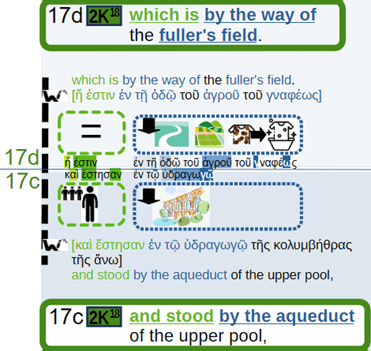
Don’t worry — you don’t need a seminary degree to feel the beauty of what’s happening here. The Greek text itself nudges us to put these two details together. You don’t need to follow every Greek nuance; the main point is that the way to fuller’s field and the aqueduct of the upper pool are folded together — and we’ll see why shortly. This wordplay isn’t present in the original Hebrew. But this isn’t the Septuagint taking artistic license; it’s the translators drawing on their mastery of Scripture to embed a Greek wordplay that remains faithful to the Hebrew.
This wordplay invites you to hold two details together: standing by the aqueduct and standing on the road — the way — to the fuller’s field. See what superimposing the aqueduct over the road to the fuller’s field does. The aqueduct was both the “road” for the water and the road to the ancient laundromat for washing garments. That double image sets the stage for the breathtaking move Mark makes next — the move that forces us to ask how the fuller’s field could possibly shape the Transfiguration.
Mark’s Intentionality Signal: The Gold Anchor
Before we walk through the Transfiguration itself, Mark tips his hand. He wants us to see a clue that sits quietly in the text but carries enormous weight. That clue intentionally links the Transfiguration to 2 Kings 18, coming through a rare Greek word — a kind of “gold anchor” — that he chooses with care.
This word appears only once in all four Gospels and only three times in the entire Septuagint. When Mark reaches for a term the other evangelists never use — and one that has only a handful of Old Testament matches — he’s pointing us somewhere. It’s Mark’s way of saying: Pay attention to that passage. I’m drawing from it.
“And His garments became shining, very white, such as a bleacher on earth is not able to make so white” (Mark 9:2–3).
The rare word is gnapheus (gnaf‑YUCE), translated “bleacher” or “fuller.” This is not merely descriptive; it opens the door to the past. It’s the very reason we’re looking into 2 Kings at all. By following Mark’s lead, parallels keep emerging.
Here’s the wonder of this gold anchor. An allusion sits right on the surface of the text — like Jacob’s ladder appearing in plain sight in John 1. Mark’s anchor works similarly, but with a deeper pull. It doesn’t merely point back to the Old Testament; it draws something hidden up to the surface.
Like an allusion, it signals that the Old Testament backstory is meant to layer its meaning onto the New Testament moment. And when this anchor drops, something remarkable happens: a Transfiguration‑like scene begins to glow inside the Old Testament itself — 2 Kings starts to radiate with the glory of Jesus. Only Mark would dare to hide a treasure in a single word. Watch for it.
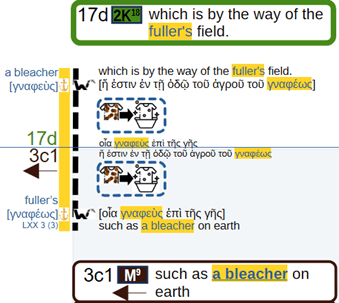
Mark does something with the Transfiguration that Matthew and Luke don’t. He draws attention to Jesus’ clothes being whiter than any bleacher on earth could achieve. Matthew notes the clothes only as “white as light,” Luke as “dazzling white.” Only Mark mentions the fuller — the washing. Why is that?
If this detail — the gold anchor — reflects the same deliberate pattern Mark has shown throughout his Gospel, then the Transfiguration is doing something far larger than we first imagined. It’s the clue that presses the question: why would Mark tie the fuller’s washing to a scene that climbs a mountain?
The Fuller’s Field and the Transfiguration
At the summit of Jesus’ glory, Mark did the unexpected. In the very moment when light broke forth, he fixes our eyes on washing — to clothes, cleansing, and the work of a fuller. It feels a little odd to stick a laundromat on the heights of glory. Yet Mark carries that image up the mountain, letting it shape how we see the summit scene. And that creates a tension we can’t ignore: why would the imagery of clean laundry follow Jesus into the pinnacle of radiance?
And then something stranger still came into view. The fuller’s field — that ancient place of cleansing — began to echo another moment in Israel’s story, a moment marked by crisis, confrontation, and three envoys standing by the aqueduct of the upper pool. The imagery refused to stay in the past. It pressed its way onto the mountain. The power of the imagery is not just that it points back, but that it points upward.
Only when the two scenes were held together did Mark’s intention emerge. The old story had woven the fuller’s field and the aqueduct into a single image; now Mark begins to mirror that pairing in his own way. He starts by clothing Jesus’ transfiguration in the language of the fuller — the imagery of cleansing. Watch how “And he was transfigured before them” fits like two puzzle pieces.
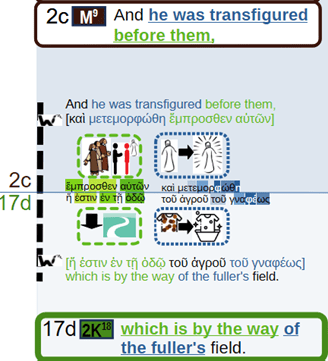
In simple terms, Mark “cloaks” Jesus’ transformation in fuller‑field, laundromat language. This does more than echo 2 Kings; it begins to show how Jesus’ glory trains His followers to lead differently. This is the moment when geography becomes theology.
The imagery of washing swells precisely at the moment when Jesus’ dammed up glory gushes into brilliance. And it brings us to one of the great takeaways of the Transfiguration: Jesus’ glory is a gift of cleansing. The glory isn’t just for Him but for us. His glory isn’t given merely to stir awe and wonder — though it certainly does that. What a laundromat does for garments, Jesus’ glory does for our lives. If that feels like a big leap, just hold onto this: Jesus brings cleansing with Him.
Jesus’ Transfiguration is glorious — it unmasks the carpenter from Galilee as the Creator from Genesis. But the moment is more than revelation; it is renovation. This isn’t spiritual stain‑remover — this is full‑cycle restoration. His church-builders need transformation. They need glory — not the glory they imagine, but the glory that cleanses. They need to see the Lord’s radiance not only as light but as laundry detergent for the soul. That is what the backstory of 2 Kings reveals — for them, and for us. All Mark’s wordplays sound-echoes and gold anchor converge on this one beautiful truth: Jesus’ radiant glory not only astonishes but transfigures His followers to radiate true light to the world.
When we glimpse the glory of Jesus, something happens inside us. Our minds are washed from the grime of lust and pride we pick up in this world. The contaminants of using Jesus for our own ends are purified. And the dominating spirit of Assyria — the impulse to get our way at the expense of others — is cleansed from our hearts. This gunk is impossible to remove except by the Spirit of glory.
What becomes unmistakable is this: our deepest need is met in the cleansing glory of Jesus. We need to see that glory.
Step back and take in the whole scene: a city under threat, an aqueduct for washing, and a mountain that becomes, in Mark’s hands, a kind of divine laundromat—where glory cleanses. All this imagery serves the Person — Jesus. Confrontation, cleansing, and radiance all converge in one unfolding story centered on Him.
Our 2 Kings account drew attention not only to the fuller’s field but also to aqueduct of the upper pool. Mark sees it too, and he carries that image as well up the mountain—where Jesus lets His brightest glory pour down to cleanse His people.
Light and Water — Mark’s Parallel Wordplay
And now the imagery begins to tighten. The fuller’s field, the aqueduct, the upper pool — these once separate threads start drawing toward a single point. The cleansing, the flowing, the descending — all of it is converging. Something in the pattern is about to come into focus, something Mark has been quietly preparing us to see.
As the threads draw together, remember how the old story paired the fuller’s field with the aqueduct. Mark now completes that mirror. After clothing Jesus’ transfiguration in the imagery of the fuller, he lifts the pattern higher still by joining the same moment to the aqueduct.
And once Mark completes the mirror, the meaning of the aqueduct comes into view. That aqueduct served as an ancient road — a path for water and, as the Septuagint wordplay did, a path for those bringing garments to be washed. This is the second half of Mark’s mirror — the fuller and the aqueduct, now refracted through the radiance of Jesus.
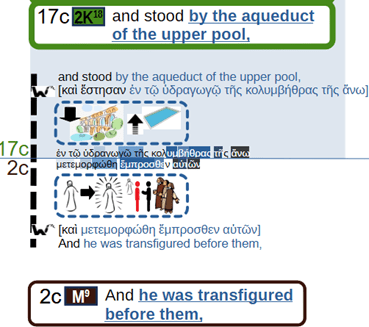
And now the imagery crests. Pause with the image for a moment — the currents are gathering, not rushing past. Mark wants us to see where they meet. Watch how he brings it to its peak.
The aqueduct of the upper pool once carried life‑giving water into a city in danger. Mark’s wordplay places that aqueduct beside the place where Jesus is transfigured before His disciples — endangered by their Assyrian instincts. And suddenly the moment sharpens. The Transfiguration is not only about bright, shining glory, like freshly cleaned clothes — it is also about something flowing, something reaching people.
Here the imagery turns personal. It’s not just a historical event. Jesus’ glory is not just something to look at. It comes to us. Jesus’ glory is not only a spotlight. It’s a river. Just as water once flowed through the aqueduct, God’s glory comes down through Jesus to give life. He is both the one who makes us clean and the one through whom God’s life and glory reach us.
Let that convergence rest for a moment. All the threads — the fuller, the aqueduct, the upper pool, the cleansing, the flowing — have now braided into a single line. The pattern is ready to speak. It’s no longer subtle. The line is unmistakable. Jesus stands in the place of the aqueduct. Let that settle in.
Everything has been leaning toward this: Jesus is the Aqueduct. Not a carved channel in rock, but the living God through whom the waters of glory descend to cleanse and pour divine life into His people. And to see the beauty of that image, we need to look again at the source — the upper pool.
In Hezekiah’s day, the upper pool was the open‑air basin where the Gihon Spring first gathered — an old, stone‑lined reservoir on Jerusalem’s eastern slope that had served the city for centuries. It was Jerusalem’s lifeline, the water source that let the city withstand siege, and its overflow ran downhill to irrigate the King’s Garden.
Water is the universal ingredient of life. Without it, plants die. We die. Jesus is the channel of divine life. His Transfiguration points to our deepest spiritual need: we need spiritual water. Tap water will never do. We need the upper pool — the heavenly source.
On Day 2 of creation, God separated the waters above from the waters below. Across the centuries, many readers have heard in those “waters above” a quiet hint of heaven’s own life‑giving supply. And as the story of redemption unfolds, that hint comes into focus: the waters above echo the Holy Spirit, the true life-giver. Without the Spirit, we die. The Spirit, then, is what Gihon only foreshadowed — the true upper pool, the living spring, the very source of life that flows through the Aqueduct, Jesus Himself.
Mark is mapping the aqueduct of the upper pool onto Jesus being transfigured before three men who desperately need cleansing — Peter, James, and John. So the point is not simply that glory descends; it descends to cleanse. The Transfiguration is the moment when the water begins to flow. It is the moment every one of us needs.
In short, the Transfiguration’s 2 Kings echoes, Greek wordplay, and symbolic geography converge into a single trajectory: Jesus’ revealed glory cleanses, reshapes, and commissions His disciples into a new kind of leader for His city. This is why the disciples must see His glory. This is why leaders must be washed. This is why the church must be cleansed of the Assyrian spirit. That spirit is death. It wedges itself between us and God. But Jesus’ glory comes to us like a river, washing away the grime of our narcissistic, self‑exalting impulses that shape our actions. Those living waters cleanse and renew. The Spirit is life. The River bends us from self to Jesus — the One of surpassing worth and our supreme delight.
And that raises the deeper question: if His glory washes like water, then where does that river begin — and where is it meant to go?
The Big Picture (The Unveiling)
An aqueduct is designed to direct water to a desired destination. That’s not just engineering; it’s theology. The aqueduct and the upper pool are not glitzy tourist attractions; they embody a theme that touches the overarching story of the whole Bible. They are entry points into the person of Jesus.
If the aqueduct image holds, then the Transfiguration is about flow as much as light — about source and destination. That double image carries more meaning than we can absorb at once — so let’s trace how Scripture unfolds it. It’ll really start clicking once you see how that same aqueduct-transfiguration current is already moving through the rest of Scripture.
Eden shows us where the lifegiving current first touched the world — a river flowing from the source so the garden could flourish. Mark wants us to see the same pattern — the true upper pool flowing through Jesus so His withered disciples can flourish in His ways, not Assyria’s.
And that river doesn’t vanish after Genesis. It is God’s pattern of restoring flourishing to the world. It reappears at the Bible’s great turning points, winding through Scripture like a whisper of water awaiting discovery.
Ezekiel sees it next: that same river growing into a promise — a river flowing from the temple, so deep and alive that the prophet walks in it as it were a road. The river is the Spirit becoming deeper, stronger, unstoppable — a cleansing current that transfigures everything it touches. And just as the trickle becomes a torrent, Jesus’ glory must become a flood strong enough to do what’s humanly impossible: washing away everything Assyrian in us — truth the apostles themselves assert later on.
It’s a sweeping story, but its heart is simple: this is how God welcomes people. The river that began in Eden and swelled in Ezekiel now flows like a canal through the eternal city of God. The Bible climaxes with the Lamb at the city’s center blazing in unveiled glory – not before a handful on a lonely mount but before all heaven and earth. And from His throne flows the river down the middle of the great street – an aqueduct, of all things — watering the tree of life and bringing the flourishing Jesus intends for His people. The aqueduct-transfiguration pattern comes into full view. Here the upper pool is finally fulfilled, the aqueduct perfected, and the flow arrives at its intended destination: the people of God.
The very design of eternity features a River — the life-giving presence of the Holy Spirit. But this is not just a river motif — it is Jesus revealing Himself across the whole story of Scripture. Jesus is the Aqueduct by which the river‑life of God reaches its intended destination: you and me. Jesus is the road for the River. He is the channel of glory. He is the One who carries the waters of Eden to the people of God.
And all of this brings us back to the mountain — to the moment when that cleansing glory first touched three withered disciples.
Jesus said, ‘Whoever believes in me, as the Scripture has said, “Out of his heart will flow rivers of living water”’ (John 7:38). For rivers to flow out of His people, rivers must first flow in. Jesus is the Aqueduct who channels the rivers of the Spirit — the true upper pool — into us.
No wonder His glory washes. No wonder His radiance cleanses. This is why the disciples needed this moment — and why we do too.
For Jesus to build His radiant church — His glorious bride — Peter, James, and John had to see this foundational truth. They could not build the church with Assyrian instincts. They could not lead with self‑exalting strength. They could not shepherd with domineering hearts. And neither can we. No amount of doing more or trying harder can change us. We are in deep need of the cleansing Jesus gives when we catch even a glimpse of His transfigured glory. We need the glory that washes. We need the Aqueduct. We need the One whose radiance purifies.
All the symmetries — the three envoys, the three disciples, the aqueduct, the fuller, the mountain, the washing, the glory — converge toward one breathtaking truth: the Mount of Transfiguration reveals God’s cleansing of His leaders. Without this cleansing, Peter, James, and John were on a trajectory that would have bent the church toward something cult‑like — marked by their authority instead of Jesus’. Without this washing, the self‑aggrandizing Assyrian spirit would have shaped the early church. Without this glory, their ministries would have drifted into monuments to themselves. It’s not about having the right lingo; it’s about having the right life.
But seeing the pattern also forces us to see ourselves. Perhaps we resemble the proud Assyrian more than the meek Jesus because we have not yet seen — or been touched by — His glory. How deeply we need the Aqueduct to cleanse us from everything Assyrian within. But Jesus washed them. And He washes us still.
So, if His glory washes us clean, then how in the world do we receive that cleansing? And the answer has been waiting for us since the very first step — hidden in Mark’s opening time‑tag, unnoticed until now. Now watch how rest walks up the mountain.
“And after six days Jesus took with him Peter and James and John, and led them up a high mountain by themselves. And he was transfigured before them.”
After six days. What comes next? The seventh day — Sabbath. Mark isn’t just giving us a timestamp; he’s echoing the rhythm of creation itself. In Genesis, the seventh day is when God rests and invites His people into His rest. By using this phrase, Mark is quietly framing the Transfiguration in the language of rest.
“After six days” is Mark’s signal: cease from your own strength. Stop striving. You don’t earn your way into a glimpse of Jesus’ glory. It is a gift to be received and enjoyed.
Jesus is your Aqueduct — the One through whom the living waters flow to you, freely and continually. The Greek word for aqueduct joins “water” and “leader,” reminding us that Jesus doesn’t merely offer water; He leads it to you. The Good Shepherd even shepherds water to His thirsty sheep.
“And let the one who is thirsty come; let the one who desires take the water of life without price” (Rev 22:17).
Jesus is the Aqueduct. Come to Him for the living water today—and receive.
This is wonderful news. But how does knowing this help me in a broken world? I cave in to the lust of the eyes, the lust of the flesh, and the pride of life far more than I care to admit. It’s frustrating. It’s discouraging. It’s shame‑soaked. And I’m an utter failure at fixing me. And Jesus never asked me to.
I know the truth, but my life feels barren — not like the garden watered by the river of God, but like dry ground waiting for rain. Like a blind man waiting to see sunshine.
Mark gently draws our attention to what comes next: the radiant clothes of Jesus. Here is where the cleansing we long for begins to take shape in our lives. But he invites us to see more than how we are washed—he shows us where that cleansing leads.
It is easy to think the goal is simply freedom from sin, a life that bears good fruit like a well-watered garden. And that is true, and it is good. But it is not the end. Transformation, glorious as it is, is not a destination but a doorway to something far, far better. We want more than fruit; we want Him. The washing leads us further—into a deep, glory-filled nearness to Jesus Himself, the kind Moses and Elijah glimpsed on the mountain. To stand in His presence is the greatest gift: to behold the Giver whose glory makes us clean, whose mercy welcomes us, and whose beauty satisfies the soul.
So the question shifts. Not only what does Jesus’ glory do — but how does that glory reach us, here and now? Mark, our sure‑footed Sherpa, will lead us a little higher up the mountain. He’ll invite us to look again at Jesus’ radiant clothes — and at the sudden, stunning appearance of Moses and Elijah. Here the story becomes wonderfully personal. Here it calls us to worship.
Glory be to Christ, whose light cleanses, whose presence draws near, and whose love welcomes us home — a foretaste of the day when we will see Him as He is.
And we are only beginning to see it. There’s more glory ahead!

